Zebra Danio Care Guide: Everything You Need to Know
Everything a first-time keeper needs to know about zebra danios, from tank size and cool water to shoal mates and the tight lid these jumping fish require.
Read article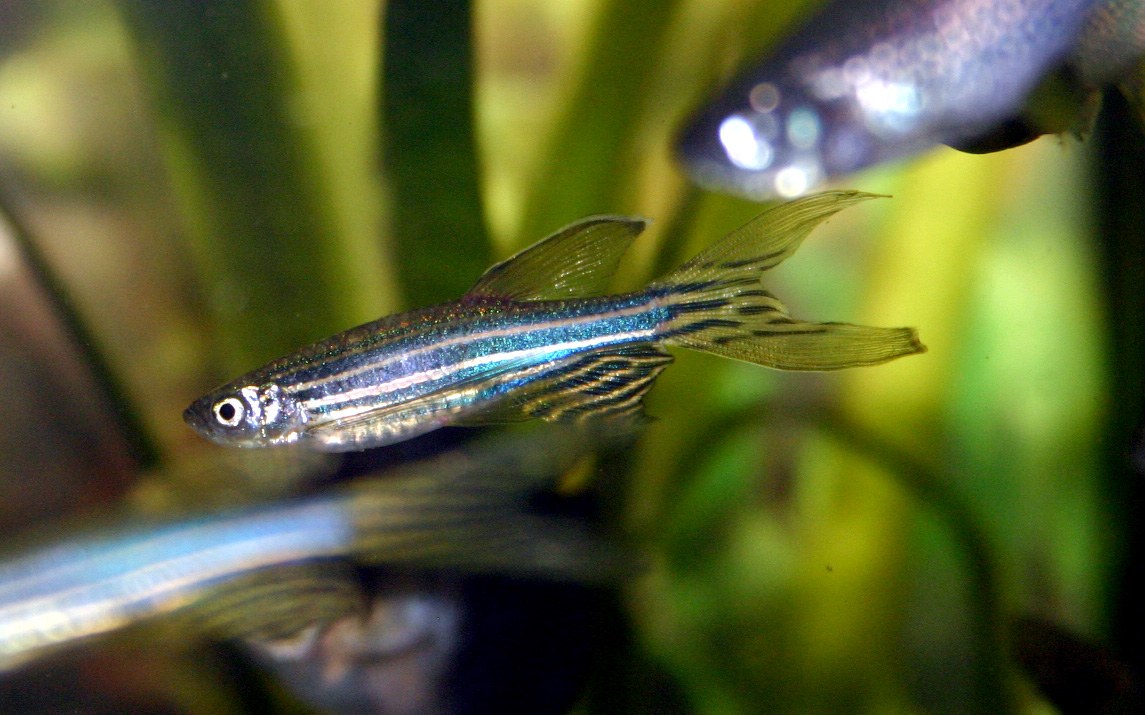
Danio rerio
A tiny striped speedster that thrives in cool water and loves the company of its own shoal.
Deep Dive
The zebra danio's story begins in the slow-moving streams, irrigation canals and flooded rice paddies of South Asia, across parts of what is now India, Nepal, Bangladesh, Pakistan and Myanmar. In those shallow, plant-fringed waters, small shoals of striped fish dart after insect larvae and tiny crustaceans, a way of life that has shaped both their body shape and their restless temperament. FishBase records the species as native to all five of those countries. Francis Hamilton described the fish for science in 1822, naming it Cyprinus rerio. It was later moved into the genus Danio, and the striped pattern that earned it the common name zebra danio is still the classic look of the species.
Zebra danios reached European and North American aquariums in the early twentieth century and quickly became a staple of the hobby. They were cheap, hardy and easy to breed, qualities that commercial fish farms in Asia have refined ever since; almost every danio sold today is farm bred rather than wild caught. The fish in your local shop has not seen a rice paddy for countless generations, but it has inherited the adaptability that made its ancestors such good survivors in changeable water.
The species also has a second career that few aquarium fish can match. Researchers began working with zebrafish in the 1970s, drawn to their fast reproduction and their transparent embryos, which can be watched developing under a microscope. The genome was sequenced in 2013, and it is now commonly cited that about 70 percent of human genes have a zebrafish counterpart. Today zebrafish are used in laboratories around the world to study genetics, development and disease. Fluorescent genetically modified varieties are sold in some countries as pets, but their status varies, so check local rules before buying them.
If a zebra danio were a person, it would be the friend who cannot sit still. These fish swim constantly, usually in loose formation, exploring every corner of the tank and investigating anything new within seconds. They are bold rather than shy, and a healthy shoal will meet you at the glass when you approach, especially if you are the one who brings food. That confidence is charming in a home aquarium, but it also means danios are rarely content in a bare, empty tank with nothing to explore.
The species is genuinely peaceful, though not entirely without attitude. Inside a shoal, fish maintain a loose hierarchy through short chases and small displays, which look dramatic but rarely cause injury. The bigger social risk is fin nipping. In a group that is too small, the energy that would normally be spread across many companions can end up directed at slow, long-finned tank mates such as bettas or fancy guppies. Keeping a proper shoal of eight or more, with open water to swim in, is usually all it takes to avoid the problem.
When zebra danios are happy, their behaviour is easy to read: bright unbroken stripes, fins held up, constant foraging and a dawn chorus of chasing that hobbyists often describe as dancing. When something is wrong, they tell you early. A danio that hides, hangs at the surface, clamps its fins or loses its colour is almost always reacting to cold water, poor water quality or a shortage of company. Because the healthy baseline is so obviously busy, changes are easy to spot, which makes this species a useful early warning system for the whole tank.
A zebra danio is built like a small torpedo. The body is slender and laterally compressed, tapering to a forked tail that provides most of the thrust for the constant swimming this species is known for. At full size the fish reaches roughly 2 inches, or about 5 cm, with females usually a little rounder and deeper in the belly than males. Two pairs of small barbels hang from the mouth, and the fins are translucent, with fine rays that often carry the striping out onto the tail and anal fin.
The pattern that gives the species its name is a series of dark horizontal stripes, a deep blue-black against a silver or gold background, running the full length of the body. In good light the pale bands show a subtle iridescent sheen, and a well-conditioned danio looks almost metallic. Farm breeding has produced several popular variations, including long-finned forms, the spotted leopard danio, and gold or albino strains with paler, warmer colouring. For most keepers the wild-type stripe remains the classic, and arguably the most reliable sign of good health.
Condition is easy to judge once you know what to look for. A healthy zebra danio has crisp, unbroken stripes, a full body that tapers smoothly to the tail, clear eyes and fins that are held erect rather than clamped against the flanks. A sunken belly, ragged or shortened fins, a dull washed-out colour or a fish that hangs apart from the shoal are all signals that something in the tank needs attention. Because the normal appearance of a danio is so vivid and so uniform across a shoal, anything that stands out is usually worth investigating straight away.
Photo credits: Marrabbio2 via Wikimedia Commons (Public domain (author dedication)). Images resized and compressed for web display.
Daily life with zebra danios is built around movement and company. A group of eight in a 20-gallon long tank will spend the day riding the filter current and investigating every plant and ornament. Because the species tolerates cool water, most homes need no heater at all, which keeps running costs low. The essentials are a cycled filter, a fine gravel or sand substrate, some hardy plants and a tight-fitting lid. With a weekly change of around a quarter of the water, a shoal is genuinely low maintenance compared with many tropical species.
Choosing companions is mostly a question of matching temperature and temperament. White cloud mountain minnows, corydoras catfish and most rasboras share the cooler end of the range, while guppies, platies and neon tetras are comfortable if the tank sits near the warmer end at about 74-75°F. Slow, long-finned fish and anything large enough to swallow a two-inch danio should be avoided. Zebra danios also do best in their own company; a shoal of six is the absolute minimum, and eight to ten is noticeably better for the fish and more interesting to watch.
A commitment to zebra danios is a commitment of three to five years, and often longer in a well-kept tank. The work is modest: two small feeds a day, a weekly partial water change, occasional filter rinsing and a daily glance at the shoal. Because danios are social, it is worth topping the group back up if numbers fall, rather than leaving a handful of fish in a tank built for a proper shoal. And when circumstances change, there is one rule that never bends. Aquarium fish must never be released into ponds, streams or canals; rehome them through a retailer, a club or another keeper instead.
At a Glance
Ownership Guide
Plan on a 20-gallon long tank or larger for a shoal of six, because zebra danios swim in fast straight lines and use every inch of length. Keep the middle open for swimming, plant the edges and fit a tight lid. These fish jump when startled, so gaps around filters and cables matter more than they do with most species.
Offer a quality micro-pellet or crumbled flake twice a day, and add frozen or live daphnia, brine shrimp or bloodworm several times a week. Zebra danios are greedy surface feeders, so give only what the shoal clears in a minute or two. Uneaten food sinks, decays and fouls the water.
Keep the tank between 64-75°F (18-24°C) at a pH anywhere from 6.0 to 8.0, and always dechlorinate tap water before it goes in. Change about a quarter of the water each week and siphon debris from the substrate at the same time. Ammonia and nitrite must always read 0 ppm.
A shoal of six or more is the best enrichment you can provide, followed by a gentle current, live plants and open swimming lanes. Zebra danios quickly learn when feeding time arrives and gather at the glass. Rotating live and frozen foods keeps them hunting, which is enrichment as much as nutrition.
White cloud mountain minnows, corydoras catfish and most rasboras share the cooler part of the range, while guppies, platies and neon tetras work if the tank sits near 74-75°F (23-24°C). Avoid slow, long-finned fish that may be nipped, and any tank mate big enough to swallow a danio. Quarantine new arrivals first.
Quarantine new fish in a separate tank for two to four weeks and never pour shop water into the display tank. Watch for white spots, ragged fins, clamped fins and unexplained weight loss. Most problems trace back to water quality, so test the water before treating anything.
Wellness
Fine white grains on the fins and flanks usually appear within a week or two of a new arrival or after a chill. Quarantine new fish, keep temperatures stable and treat the whole tank as directed rather than moving a sick fish around.
Ragged, pale or shortened fin edges point to a bacterial infection, usually secondary to poor water quality or a nipped fin. Improve water changes, confirm that ammonia and nitrite read zero, and treat in a hospital tank if the damage continues.
Gradual weight loss with a hollow belly can indicate mycobacteriosis, a chronic condition that is generally considered incurable. Remove affected fish, never feed raw or spoiled food, and disinfect nets and siphons between tanks.
Zebra danios beg convincingly and are easy to overfeed, which leads to bloated fish, cloudy water and rising nitrate. Feed small portions twice a day, skip a day each week, and siphon out anything that reaches the substrate.
A startled danio can clear an open top and end up on the floor. Fit a tight lid, check for gaps around pipes and cables, and keep the water level a little below the rim so the fish cannot simply ride over the edge.
Zebra danios are comfortable from 64-75°F (18-24°C), which means most homes need no heater at all. That tolerance makes them one of the few tropical-looking species suitable for an unheated indoor tank.
In a group of eight or more, danios direct their energy at each other and settle into a calm community rhythm. Nipping problems are almost always a sign of a shoal that is too small or a tank with too little open water.
Further Reading
Everything a first-time keeper needs to know about zebra danios, from tank size and cool water to shoal mates and the tight lid these jumping fish require.
Read articleWhat zebra danios eat, how much to feed them and how often, plus a simple weekly feeding plan that keeps the water clear and the shoal healthy and bright.
Read articleThe health problems zebra danios are most likely to face, how to spot them early, and the quarantine and water quality habits that prevent most of them.
Read articleWhy zebra danios shoal, chase, jump and patrol the surface, and what those everyday habits can reveal about the health of your aquarium and your fish.
Read articleHow to keep a zebra danio tank clean and stable, from weekly water changes and filter care to gravel cleaning and reading the results from your water tests.
Read articleWhat daily life with zebra danios is really like: morning chases, feeding routines, children, tank mates, lifespan and how to rehome them responsibly.
Read articleYou May Also Like