Guppy Care Guide: Everything You Need to Know
A complete guppy care guide covering tank size, water parameters, tank mates, feeding and fry management for beginners setting up a first tropical tank.
Read article


Poecilia reticulata
A peaceful livebearer that fills a warm tank with color, movement and a steady supply of fry.
Deep Dive
The guppy takes its common name from Robert John Lechmere Guppy, a British-born naturalist living in Trinidad who sent preserved specimens to the British Museum in the 1860s. The fish already had a scientific name, Poecilia reticulata, given by Wilhelm Peters in 1859 from Venezuelan material, but the museum's Albert Guenther named his Trinidad specimens Girardinus guppyi in Guppy's honor, and the nickname stuck.
On Trinidad and Barbados the fish was so abundant that it was simply called the millions fish. Its appetite for mosquito larvae made it an obvious ally in public health campaigns, and from the early twentieth century it was shipped around the world to stock drains, canals and rice fields. Many of those introductions took hold, and wild guppies now live on every continent except Antarctica, often far from their native streams.
Selective breeding in the aquarium trade began in earnest in the early 1900s and has produced an extraordinary range of color and fin forms, from plain wild-type fish to show strains with enormous tails. Modern fancy guppies are the result of more than a century of line breeding, which explains why a farm-bred fish can look nothing like the modest olive and orange guppy of a Trinidad ditch.
Guppies are peaceful, active and almost endlessly curious. They live in loose groups rather than tight schools, drifting apart to graze and coming back together when something interesting appears. A group gives a tank a sense of constant, gentle motion, with males showing off and females working steadily along the plants.
Male guppies are the show-offs of the species. They court almost continuously, spreading their fins and darting around females in short, hopeful bursts. Competition between males is mostly display, and serious aggression is rare. The real risk is exhaustion for a female who never gets a break, which is why keepers aim for two or three females per male.
Females are calmer and far more interested in food, and they generally live longer than males. Guppies are not territorial and usually ignore other peaceful species, though they will chase smaller fish away from food and can be nipped by larger or faster tank mates. Their interest in people is learned rather than affectionate: they quickly connect a face or a hand with feeding and will follow movement along the glass. Guppies are also remarkably tolerant of a busy household: they ignore footsteps, vacuum cleaners and kitchen noise, and they settle faster than most small fish after a water change or a tank move.
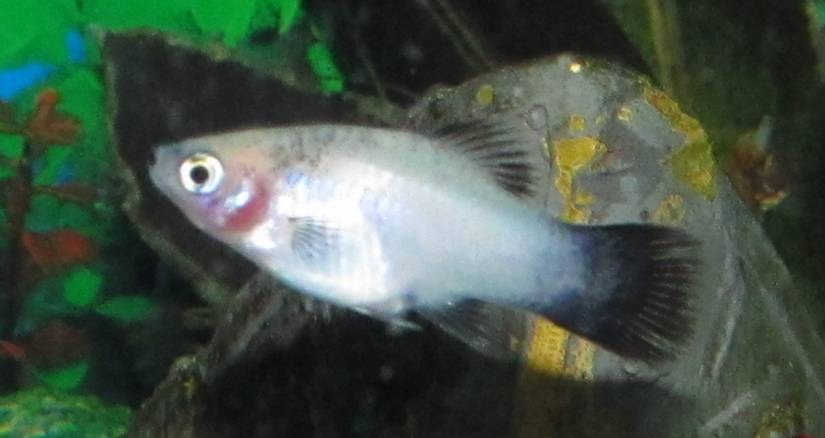
Male and female guppies look so different that beginners often assume they are two species. Males are smaller, usually about 3 to 4 cm, with slim bodies and large, brightly patterned fins. Females are longer and rounder, reaching 5 or 6 cm, and are mostly silver-grey with color usually limited to the tail.
The male's anal fin has become a gonopodium, a narrow rod used to deliver sperm, and his body carries the color that made the species famous: oranges, reds, blues, greens and blacks arranged in spots, snakeskin patterns, cobra markings or shimmering metallic patches. Fancy strains add huge delta, fan or lyre tails, and hybrids with the closely related Endler's guppy are common in shops.
Females show their condition clearly. A mature female has a dark gravid spot near the rear of her belly, and as fry develop she becomes deep-bodied and squared off. Wild-type guppies are modest in color, so if you want a particular look, buy from a breeder who can show you the parents rather than picking fish at random from a mixed tank. Whatever the strain, the practical difference is size and fin length: heavy tails need gentler current and a little more space, while short-finned types tend to be the most active.
A guppy group is one of the friendliest introductions to fish keeping. The fish are small, peaceful and visible, they come to the front of the tank for food, and children can watch the whole life cycle, from courtship to tiny fry, without any special equipment. A 10 to 20 gallon tank suits a small group, and the routines involved are short. Adults are the easiest fish in the house to care for on a busy day: no walking, no grooming and no noise, just a small daily job that takes two minutes.
Day-to-day life is simple: two small feeds, a look at every fish and a weekly water change. The complication is reproduction. A single female can produce dozens of young every month, so a mixed group needs a plan for the fry, whether that means a separate raising tank, a natural balance among plants and adults, or rehoming the extras.
Guppies do best in warm, hard, alkaline water, between 22 and 26C (72 to 79F) and pH 7.0 to 8.2. They are not suited to cold water, to an uncycled new tank or to a bowl, and they must never be released outdoors, where they can establish wild populations and compete with native species. Given a cycled filter, a heater and a little patience, they are among the most rewarding first fish available.
At a Glance
Ownership Guide
Plan on a 10 to 20 gallon tank for a small group, with a filter, an adjustable heater and a lid. A larger volume keeps warmth and waste diluted, and guppies breed fast enough that the extra space will be used. Add live or silk plants so fry have somewhere to hide.
Feed a quality micro-pellet or flake twice a day in portions the group clears within two minutes, and add frozen or live foods such as brine shrimp and daphnia several times a week. Guppies are omnivores and benefit from a little plant matter. Remove uneaten food before it fouls the water.
Keep ammonia and nitrite at 0 ppm and nitrate low with weekly changes of 20 to 25 percent using dechlorinated, temperature-matched water. Rinse filter media in old tank water, never under the tap. Nothing that touches the tank should ever meet soap or detergent.
Guppies are not fish you train, but they learn routines quickly and will gather at the same corner at feeding time. Live plants, gentle current and open swimming space keep them active and displaying. Feeding at consistent times makes daily health checks easy.
Choose small, peaceful fish that share warm, slightly hard water, such as corydoras, harlequin rasboras and platies. Avoid fish large enough to swallow a guppy, known fin nippers and coldwater species. Keep two to three females per male so courtship is spread evenly.
Quarantine new arrivals for two to four weeks in a separate tank and use dedicated equipment for it. Check the group every day for changed appetite, clamped fins, spots or gasping, and test the water before treating anything. Healthy guppies are the product of clean water and stable temperatures.
Wellness
Fins look ragged, shortened or edged with white, red or dark tissue. It usually follows poor water quality, stress or nipping, and it improves once conditions are corrected and the fish is isolated for observation.
Small white grains appear on fins and skin, often with rubbing against decor and faster gill movement. It spreads quickly in warm, crowded tanks, so check water quality and seek advice on a treatment that covers the whole life cycle.
A fine gold or rust-colored dusting on the skin, usually with clamped fins, scratching and weight loss. Stress from transport or a temperature drop often comes first, so keep new arrivals isolated and warm.
Gasping at the surface, reddened gills and listless swimming point to toxic water. Both readings must be 0 ppm, so change part of the water immediately and retest until the filter catches up.
A healthy guppy holds its fins open and smooth, with clear eyes and even color. These simple signs are the best daily benchmark for the whole group.
Guppies should meet food eagerly at every meal and stay interested in their surroundings. A fish that skips more than a day of feeding deserves a water test and a close look.
Expect constant, level movement through the middle and upper water. Fry that dash for cover are behaving normally, but an adult that hides or sits on the bottom is not.
Further Reading

A complete guppy care guide covering tank size, water parameters, tank mates, feeding and fry management for beginners setting up a first tropical tank.
Read article
What guppies really need to eat, how much to offer each day, and how to build a varied weekly menu that keeps adults colorful and growing fry healthy.
Read article
How to spot a healthy guppy, recognize fin rot, whitespot and other common problems, and prevent most illness with clean water and a simple daily routine.
Read article
Why male guppies chase each other, what females do all day, and how guppy behavior changes when something in the tank needs your attention right away.
Read article
A practical guppy tank maintenance routine: weekly water changes, filter care, water testing and the equipment that keeps a small tank stable and clear.
Read article
What daily life with guppies really looks like, from feeding routines and children to holidays, fry planning and choosing the right first fish for your home.
Read articleYou May Also Like