Neon Tetra Care Guide: Everything You Need to Know
A complete neon tetra care guide covering tank size, soft acidic water, planted setup, feeding, tank mates and the quarantine habits that keep them safe.
Read article

Paracheirodon innesi
A living ribbon of blue and red that brings the calm of the western Amazon to any planted tank.
Deep Dive
The neon tetra entered the aquarium world in the 1930s, when collectors working in the Peruvian Amazon shipped a small and impossibly bright fish back to Europe and the United States. It was scientifically described in 1936 and named in honour of William T. Innes, an American aquarist and publisher whose writings did so much to popularise the hobby. Almost a century later it remains one of the best selling aquarium fish on the planet.
Its wild home is the western Amazon basin, in the clear and blackwater tributaries that thread through Brazil, Colombia and Peru. The water there is soft, warm and slightly acidic, shaded by forest canopy and stained by fallen leaves, and it carries very little dissolved mineral content. That habitat explains nearly every care recommendation that follows: the neon tetra is built for quiet, dim, chemically gentle water, not for bright, hard, heavily stocked tanks.
Most neon tetras sold today are bred on fish farms rather than collected from the wild, and decades of captive breeding have kept the species affordable and widely available. Wild caught fish still reach the trade from the Peruvian Amazon, however, and these arrivals can be more delicate and more likely to carry parasites. Whichever type you buy, the species itself has not changed: the same shoaling instincts, the same sensitivity to stress, and the same unmistakable stripe that made it famous.
Ask keepers what they love about neon tetras and the answer is rarely the individual fish; it is the shoal. In a group of six, eight or ten, neons behave like a single loose organism, drifting, turning and settling together. Each fish is timid on its own, and the group is what transforms that timidity into confidence. Kept alone, a neon hides, fades and eats poorly. Kept in numbers, it occupies the middle of the tank and ignores the world.
Compared with many community fish, neons are remarkably undemanding socially. They have no territories to defend, no hierarchy to enforce and no interest in bullying tank mates. Males may chase one another briefly when a female is ready to spawn, but real aggression is vanishingly rare. Their impulse in every conflict is to move away, which is why they do best with small, gentle companions that share their taste in soft water.
The one thing a neon shoal cannot tolerate is disruption. Sudden light, a heavy hand in the tank, a new and much larger fish, or a swing in temperature all push the group into hiding, and colour fades within hours. Handled calmly, the same fish are active and surprisingly bold, rising at feeding time and inspecting the glass when you approach. It is a quiet, steady personality, best appreciated slowly.
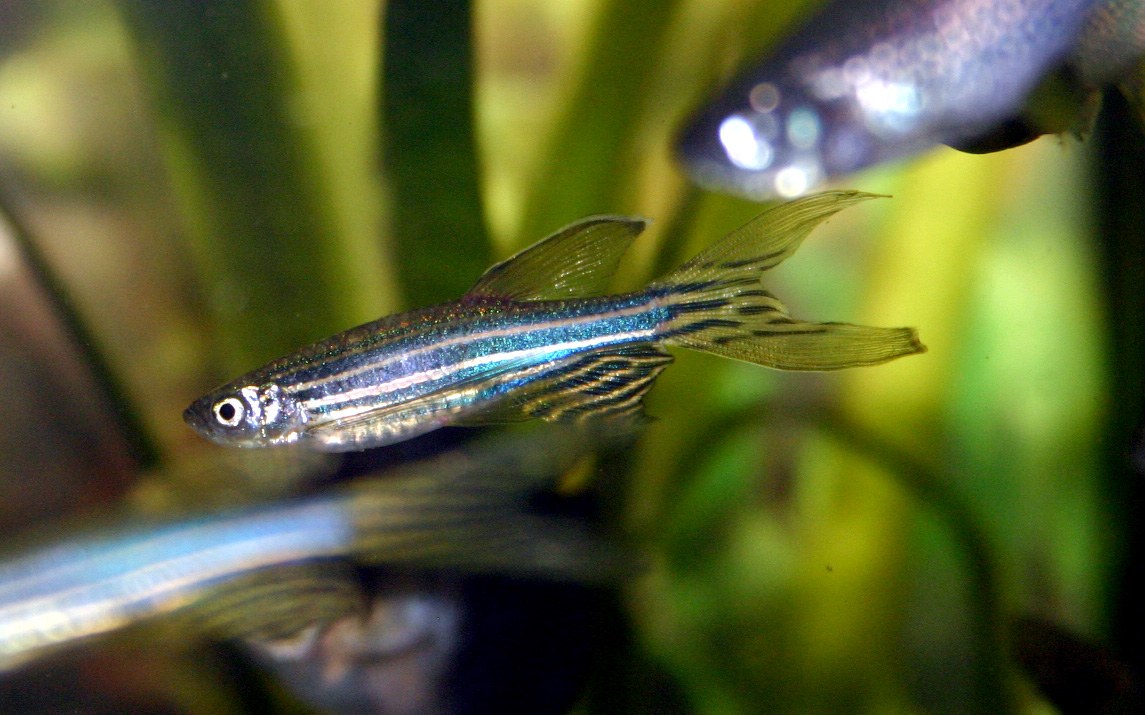
The neon tetra is a small scale masterpiece. Its body is slender and torpedo shaped, barely 1.2 inches (3 cm) at full size, with transparent fins and a silver white belly. Along the upper half runs an iridescent blue green stripe that seems to glow from within, and beneath it, on the rear half of the body, a second stripe of vivid red completes the pattern.
That famous blue is not pigment. It is structural colour, produced by microscopic crystals inside specialised cells called iridophores, which reflect light much as a soap bubble does. This is why the stripe appears to shift and dim as the fish turns, and why colour drains so visibly when a neon is stressed: the fish is not painting over the stripe, it is switching it off. The red stripe, by contrast, is true pigment.
Males and females look alike, but adult females are noticeably fuller bodied and slightly larger, with a rounder belly line, while males stay slimmer and straighter underneath. Juveniles reach shops still wearing a faded version of the adult pattern and colour up over several weeks in a good tank. Do not confuse the neon with its cousin the cardinal tetra, whose red stripe runs the full length of the body, or with the green neon tetra, which has no red at all.
Living with neon tetras is closer to keeping a small water garden indoors than raising a conventional pet. There is nothing to walk or groom, no noise, no fur on the sofa, and no need for daily hands on attention. What you get instead is a living, moving picture that changes hour by hour and rewards only two things: patience and consistency.
The practical rhythm is gentle. Feeding takes a couple of minutes twice a day, and a weekly session of twenty to thirty minutes covers the water change, a water test and a quick look at plants and equipment. A ten to twenty gallon planted tank fits on a sideboard, costs little to run, and suits flats, offices and family homes equally well. Children can take part in supervised jobs, though the fish themselves are for watching rather than handling.
The commitment side deserves real thought. A neon shoal is a five to eight year promise, not a season long experiment, and moving house, changing jobs or starting a family all need a plan for the tank. The good news is that fish are among the easiest pets to care for well; the trouble is that they cannot tell you when something is wrong. Budget the time before you buy, and the keeping itself is genuinely simple.
At a Glance
Ownership Guide
Plan on ten to twenty gallons for a single shoal, with the larger size making stable water far easier to achieve. Set the tank up with a dark substrate, driftwood and plenty of live plants, including floating species that soften the light. Dim, shaded conditions suit neon tetras best, and a mature filter is essential before any fish arrive.
Feed small particles: micro flakes, finely crushed granules, and frozen or live foods such as daphnia and baby brine shrimp. Two small portions a day, each cleared within a minute or two, keep neons in condition. Variety matters more than any single brand.
Aim for soft, slightly acidic water at pH 6.0 to 7.0 and a steady 68 to 79 degrees Fahrenheit (20 to 26 degrees Celsius). Change twenty to thirty per cent of the water weekly, always dechlorinated and temperature matched. Ammonia and nitrite must read zero at all times.
Neon tetras do not learn tricks, so enrichment means a natural, secure territory: dense planting, shaded corners, gentle current and the company of a proper shoal. Floating plants overhead are especially valuable because they let the fish choose how much light to sit under. A calm, varied environment brings out the natural behaviours that make a shoal worth watching.
Choose small, peaceful fish that enjoy the same soft water: glowlight and ember tetras, harlequin rasboras, corydoras and otocinclus all work well. Avoid large, boisterous or nippy species, and never mix tropical neons with goldfish, whose cold, hard water is the opposite of what they need. Quarantine every newcomer for two to four weeks before it joins the shoal.
Quarantine new fish for two to four weeks and keep one set of tools per tank, because shared equipment spreads disease. Watch for faded colour or white patches, which can signal the incurable neon tetra disease. Clean water, stable temperature and a low stress tank remain the best medicine available.
Wellness
A parasite called Pleistophora hyphessobryconis causes pale patches, fading colour and a curved spine, and there is no reliable cure. Prevent it with quarantine, strict equipment hygiene and by never feeding sick or dead fish to tank mates.
Fine white grains on the fins and body usually arrive with new fish or follow a cold spell. Seek expert advice and treat early, and always quarantine arrivals before they meet the shoal.
Ragged, milky or shortening fins point to bacterial infection, almost always after stress or poor water quality. Correct the water first, then treat under expert advice.
Both compounds burn gills and must read zero in a cycled tank. Test immediately if fish gasp at the surface or hang near the filter outlet.
A full blue and red stripe is the clearest sign that a neon is relaxed and well kept. Colour that stays faded for days deserves a water test.
Healthy neons move as a loose group in midwater and rejoin it quickly after a fright. A fish that stays apart is usually the first sign of trouble.
Neons should rise eagerly at feeding time and clear their portion in a minute or two. A sudden loss of interest always deserves investigation.
Further Reading

A complete neon tetra care guide covering tank size, soft acidic water, planted setup, feeding, tank mates and the quarantine habits that keep them safe.
Read article
What neon tetras eat in the wild, how often to feed them, and how to choose flakes, pellets and frozen foods that keep their colours bright and bodies strong.
Read articleNeon tetra disease, ich, fin rot and water quality problems: how to spot the early signs, prevent outbreaks with quarantine, and when to seek expert help.
Read articleWhy neon tetras shoal, what their glowing stripe communicates, how they behave at night, and how to read the early signs of stress before problems start.
Read articleA simple maintenance routine for neon tetra tanks: weekly water changes, filter and heater care, water testing, and cleaning without soap or harsh chemicals.
Read articleWhat daily life with a neon tetra shoal is really like: routines, costs, children and tanks, holidays away, and the responsibility of a long-lived pet.
Read articleYou May Also Like