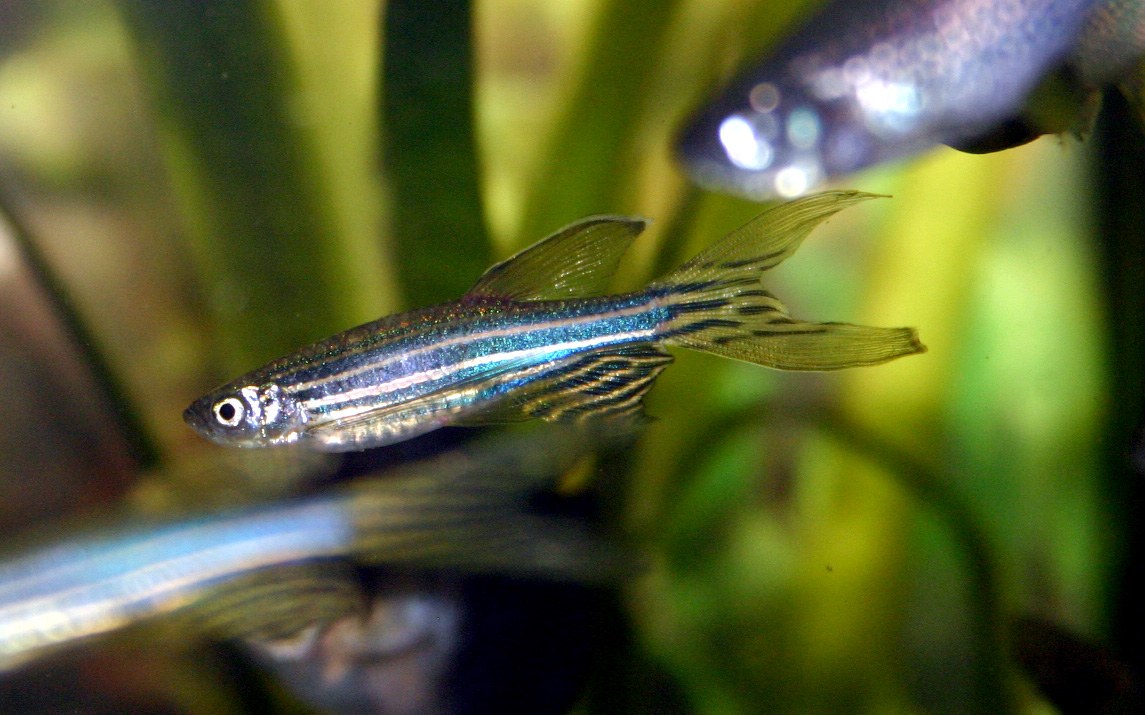
Zebra danios are not subtle fish. They dash, they bicker, they chase and they spend hours riding the filter current like tiny patrol boats. Understanding those habits turns a confusing blur of activity into a running commentary on the health of your tank.
A Fish Built for Speed
Everything about the zebra danio's body says continuous motion. A slim, torpedo-shaped frame, a forked tail and fins that fold flat against the flanks all reduce drag. In the wild these are fish of moving water: streams, channels and flooded fields where food arrives with the current.
In the aquarium that design becomes a need. Danios swim the length of the tank dozens of times an hour, often in loose formation, and never quite settle. A tank with a modest current is not merely acceptable to them; it is home, and a filter that turns the water over slowly will keep the shoal calmer and more predictable.
Because they are always moving, they work as an indicator species. The day a shoal stops swimming is the day something has changed. Slow, listless danios are not resting; they are usually reacting to cold, to poor water quality or to constant disturbance around the tank.
Shoaling: Why Company Matters
The shoal is the zebra danio's survival strategy. Many pairs of eyes watch for danger, no single fish has to lead, and food found by one fish is quickly found by all. In a group of six or more you will see constant small adjustments as fish swap positions, break away and rejoin.
Kept alone, the same fish changes character. Its colour fades, it hangs near cover and it may refuse food for days. Two or three together is only a partial fix. A proper shoal of eight or ten shows the species at its best: bright, bold, and busy from morning to night.
There is a social order inside a shoal, maintained by brief chases and small displays rather than real fighting. Serious damage is rare, and the hierarchy seems to keep the group calm rather than in constant conflict. Watch for a few minutes and you will see the same fish taking the front position over and over.
A shoal also influences the rest of the tank. Shy bottom dwellers such as corydoras settle faster when confident, always-visible danios are swimming above them, a calming effect fish keepers call dithering. If you keep nervous species, a danio shoal is one of the simplest improvements you can make.
Chasing, Sparring and Spawning
Some of the most dramatic behaviour happens in the first hour after the lights come on. Males chase females through the plants, shimmy alongside them and jostle for position. It looks frantic, and a beginner might mistake it for aggression, but in a healthy shoal it almost never causes damage.
Zebra danios are egg scatterers. In the wild a pair swims over moss or gravel, releases eggs and milt, and moves on without a backward glance; neither parent offers any care to the eggs or the fry. Spawning is often triggered by a cool water change that mimics the arrival of the monsoon, which is why a partial water change with slightly cooler water frequently produces a dawn chase the next day.
Females carrying eggs look noticeably rounder and fuller than males, while males tend to be slimmer with a sharper line between the pale belly and the striped flank. In a mixed shoal, both are usually easy to tell apart at a glance, and the difference becomes most obvious in the minutes before a spawn.
Because eggs are scattered and adults will eat them, breeding happens whether you plan for it or not. If you want fry to survive, provide fine-leaved plants or a spawning mop, and move the adults to another tank once the chase is over.
Feeding Time at the Surface
Zebra danios feed in the top third of the water column, intercepting anything that falls from above or drifts past in the current. Put your hand over the tank and the shoal will already be gathering, a clear sign that daily life has taught them who brings dinner.
Watching a feed tells you a good deal about the group. Fish that rocket to the surface and grab food are confident. Fish that hang back and pick at missed flakes may be new, bullied or unwell, and are worth watching over the next few days.
They also mouth things they cannot eat, including small snails, plant fragments and occasionally fingers. This is curiosity rather than aggression, but it explains the odd tug when you are working in the tank. It is also why food and small objects should never be left within reach of an open top.
The hunting instinct is strong enough that live food produces visible excitement: tighter shoaling, quick turns and sudden bursts of speed. Small amounts of live or frozen food offered often are one of the easiest ways to keep the shoal occupied and engaged, and the zebra danio diet guide covers what to offer and how much.
Jumping, Dashing and Hiding
Danios jump. It is not a flaw in their character but an evolutionary skill. In shallow, changeable water, being able to leap away from a hazard is a survival advantage, and in a tank the same reflex fires when a fish is startled, chased or overexcited at feeding time.
Water parameters can push them to the surface as well. Ammonia or nitrite, low oxygen or water that is too warm will all bring fish up to the top of the tank and increase the chance of a leap. If your danios suddenly seem to hang at the surface, test the water before you assume the lid is the only issue.
Glass surfing, where a fish swims up and down along one pane, is usually a sign of stress: too small a tank, a reflection from a mirror or television, or a shoal that is too small to feel safe. Adding company and cover normally settles it within a week.
What Your Danios Are Telling You
Content danios are boringly predictable. They swim, they bicker, they eat, and their stripes stay sharp and bright. That steady baseline is exactly what makes change easy to spot.
Pale colour, tucked fins, hiding and refusing food point to stress. Rapid gill movement points to a water quality or oxygen problem. A fish that isolates itself in the opposite corner of the tank is often ill, and it is the one to watch closely for the next day or two.
Daily rhythms matter as well. Most shoals are busiest at dawn, quieter in the middle of the day and lively again in the evening, with a still period once the lights go out. A shoal that is active at the wrong times, or that never settles at all, is usually dealing with light pollution, disturbance or water that is too warm.
Learn your shoal's normal rhythm over a month and you will notice a problem on the same day it starts, which is exactly when it is easiest to fix.
Continue reading: Zebra Danio Tank Maintenance: Cleaning, Water & Equipment.
Sources and further reading:
- Seriously Fish: Danio rerio (Zebra Danio) species profile
- FishBase: Danio rerio summary
- MSD Veterinary Manual: Routine Health Care of Fish
- USGS Nonindigenous Aquatic Species: zebra danio
- Zebrafish Models of Human Disease: Gaining Insight into Human Disease at ZFIN
Photo credits: Marrabbio2 via Wikimedia Commons (Public domain (author dedication)). Images resized and compressed for web display.

