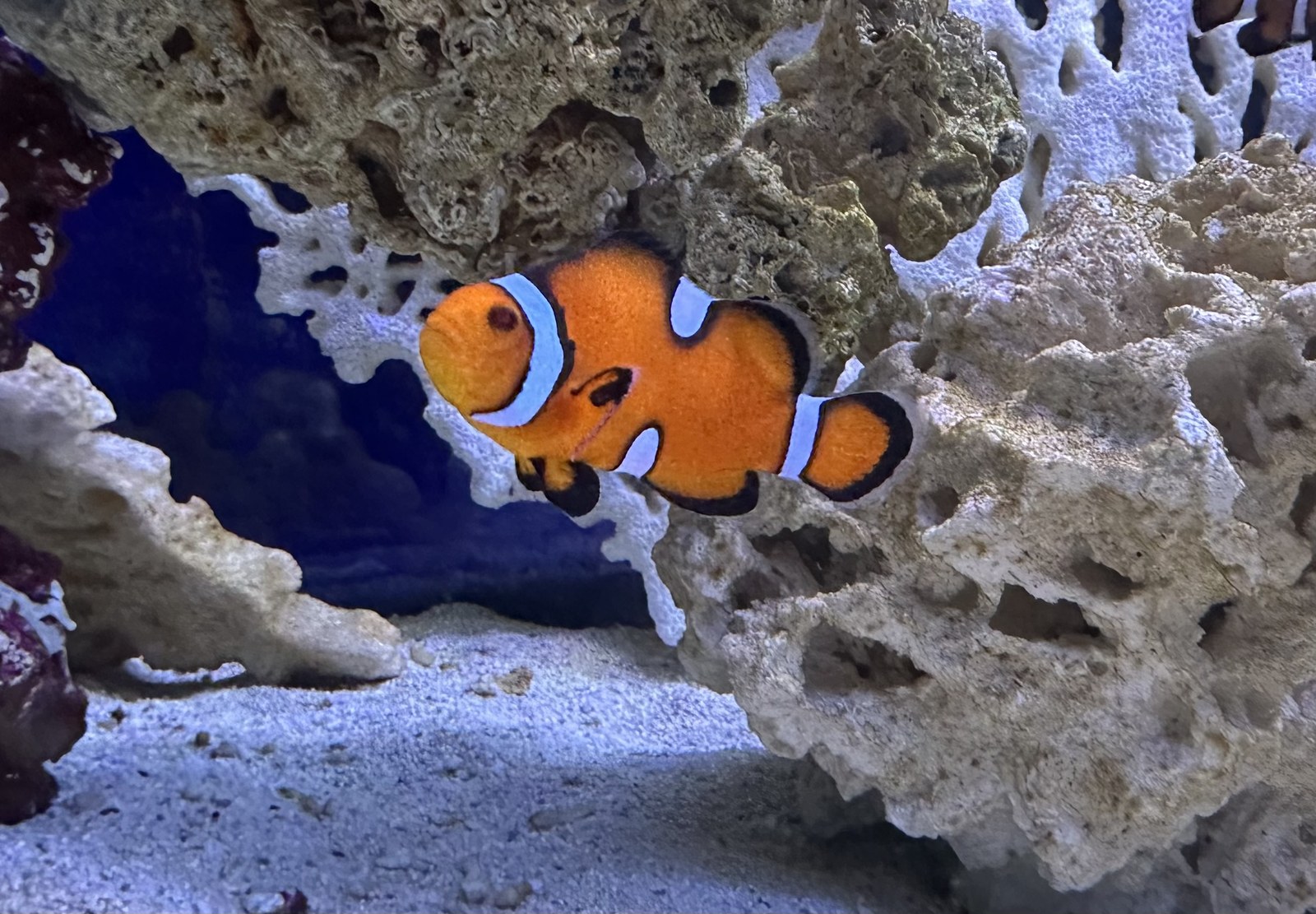
Clownfish tank maintenance becomes much clearer when you separate two jobs that both involve adding water. Evaporative top-off replaces water that left the aquarium without its salts. A water change replaces seawater deliberately removed with its dissolved salts and wastes. Confusing those jobs can alter the environment of Amphiprion ocellaris even when the tank looks immaculate. A few careful measurements are more useful than an elaborate routine performed by habit.
Understand what left before replacing it
During ordinary evaporation, water leaves while dissolved salts remain, making the remaining seawater more concentrated. Replace that evaporative loss with suitable freshwater, commonly reverse-osmosis/deionized water. Do not add marine salt simply because the aquarium is a saltwater system. Repeated saltwater top-offs would keep adding salts that did not evaporate.
A partial water change is different. Siphoning removes seawater, so the normal replacement is correctly prepared marine saltwater, matched to the system's intended conditions. Similarly, a leak or substantial wet-skimmed water loss removes salts as well as water and should not automatically be treated as evaporation.
Check the cause of an unexpected level change before refilling. If the level falls unusually fast, inspect equipment and the surrounding area rather than allowing an automatic system to conceal a leak. Knowing what was lost lets you choose the right replacement instead of correcting one measurement while quietly damaging another.
Know what your measuring instrument reports
Salinity expresses salt concentration. Specific gravity is a density ratio with temperature and reference conventions involved. An instrument may display either or both, but that does not make the scales interchangeable. A reading of specific gravity should remain labeled as specific gravity in your records.
OATA lists specific gravity of 1.020-1.025 for clownfish care. Its accompanying 24-26 C range is aquarium water temperature, not a stated SG calibration condition. Do not claim that the source defines an exact parts-per-thousand equivalent at a particular temperature when that information is not provided.
Use a seawater-suitable instrument and follow its instructions for calibration, sample temperature and reading. Automatic temperature compensation operates within an instrument's design limits; it does not regulate the aquarium or eliminate the need to measure water temperature. Verify surprising readings with a sound method before making a large correction, and seek specialist help if the measurement conventions remain unclear.
Prepare water changes outside the aquarium
Use a dedicated container, suitable source water and a marine aquarium salt mix. Follow the salt manufacturer's order of mixing, circulation requirements and preparation time. Fully prepare the replacement water before use rather than adding dry salt where it can contact fish or other livestock.
Check temperature and salt concentration after mixing and before transfer. Choose a consistent operating target appropriate to the fish and the complete system, not a different point in the published range at each water change. If the aquarium has drifted markedly, obtain a controlled correction plan instead of attempting an abrupt reset.
- Label containers freshwater or prepared seawater.
- Keep household cleaning products away from both.
- Verify the replacement water before draining.
- Record the amount changed and any unusual readings.
Never substitute table salt for a marine mix. Seawater preparation involves more than adding sodium chloride to tap water.
Make top-off reliable without making it invisible
Mark the normal operating level in the correct part of the system and check it consistently. In systems with a sump, evaporation may show most clearly in a particular chamber; learn how your own plumbing behaves. Use measured freshwater additions rather than guessing from the display's appearance.
An automatic top-off device can reduce routine variation, but it introduces sensors, pumps and reservoirs that need inspection. Position equipment according to the manufacturer, provide appropriate safeguards and ensure a reservoir failure cannot deliver an uncontrolled amount of freshwater. Test the setup before relying on it during travel.
Inspect for salt deposits and splashes around equipment while keeping electrical connections dry. Significant saltwater losses require their own assessment. Regular direct measurements remain necessary even when the water level appears perfectly stable every day.
Remove waste while preserving filtration
Observe the aquarium's nutrient trend alongside feeding and stocking. Test ammonia, nitrite and nitrate, and assess pH and other system-relevant parameters with suitable methods. Ammonia and nitrite should not be detectable in an established, functioning aquarium. Do not assume a small pair produces too little waste to require testing.
Siphon accessible debris without destabilizing structures or repeatedly chasing the fish out of its preferred area. Service mechanical filtration as needed and maintain biological media according to the equipment instructions. Avoid wholesale replacement or disinfection of established biological media as ordinary cleaning. Microorganisms are part of the working system, not dirt to eliminate.
Inspect pump guards, flow paths and any skimmer in use. A skimmer can contribute to waste removal but does not excuse uncontrolled feeding or eliminate the need for water changes. OATA recommends a 25% partial water change at least weekly as a routine starting reference. Adjust the plan to measured water quality and the complete livestock load with experienced advice; it is not a universal emergency-correction recipe.
Close the session with a system check
After maintenance, confirm the intended water level, stable temperature and verified salt concentration. Check that pumps, heaters and any feeding modes are back in normal operation. Inspect hose connections and nearby surfaces for leaks, then watch both clownfish for comfortable respiration and coordinated movement.
Keep a brief record of water changes, calibration and equipment work. If a problem appears later, that history helps distinguish a slowly developing nutrient issue from an error introduced during the last maintenance session. Save the instrument instructions where they can be found instead of relying on memory.
A well-maintained marine aquarium is not defined by constant chemical adjustments. It is a system whose inputs and losses you understand. When you know which water belongs in which container, what your instrument measures and why the filter must stay biologically active, routine care becomes both safer and more predictable.
Continue reading: Living With Ocellaris Clownfish: Keep the Marine Project Manageable.
Sources and further reading:
- Clown Anemonefish (Amphiprion ocellaris) - Florida Museum of Natural History
- Amphiprion ocellaris - FishBase
- How to look after clown fish - OATA
- Ocellaris Clownfish Care Guide - Coralife
Photo credits: Bruxton (CC0), Bruxton (CC0), Bruxton (CC0). Images resized and compressed for web display. Each image retains its linked license.


