Boston Terrier Care: A Comfortable Routine From Day One
Build a Boston Terrier care routine around comfortable breathing, cool spaces, gentle activity, daily checks, and practical plans for a safe, settled home.
Read article


Canis lupus familiaris
A bright Boston companion whose comfort matters more than keeping up.
Deep Dive
The Boston Terrier developed in Boston, Massachusetts, rather than being a British terrier imported in its finished form. British Bulldog and English White Terrier ancestry contributed to its foundation, and the Royal Kennel Club account identifies the Liverpool-bred Hooper's Judge as an important early dog brought to America. The breed's name reflects the American city where that ancestry was developed into a distinctive companion. The AKC places it in the Non-Sporting Group, the label PetlyWise follows; the UK uses the different label Utility. These are registry groupings, not instructions about how much activity a dog needs or a claim that every member has the same personality.
The familiar nickname American Gentleman refers to the tidy, white-marked appearance often compared with formal clothing. It is an affectionate description, not evidence that puppies arrive with finished manners. Today's Boston still needs patient teaching, appropriate social experiences, and an environment that supports rest. Its compact outline can make it appealing in a city home, but an apartment does not remove the need for outdoor opportunities or reliable cooling. History also cannot tell you whether an individual breathes comfortably, hears in both ears, or enjoys children. Ask for medical records and observe the actual dog rather than choosing from a breed story alone. PetMD gives a typical lifespan of eleven to thirteen years; treat that as a planning estimate, with provision for both unexpected illness and a longer commitment. Health and quality of life matter more than achieving a particular birthday.
Many Boston Terriers are lively, people-oriented companions that enjoy a short game followed by settling near someone familiar. A loose body, willing approach, and easy withdrawal tell you more about enjoyment than a wagging tail alone. Some individuals greet visitors enthusiastically; others prefer distance or need time to become comfortable. Early experience, age, pain, sensory ability, and the household's routines all influence behavior. The trait scores are editorial tendencies, not measured breed averages or promises about your dog. An older Boston may favor sniffing over chasing, while a youngster may need help learning that quiet rest is rewarding too.
Intelligence does not make a dog immune to confusion. Reward a clear, achievable behavior, keep practice brief, and change the setup when your Boston struggles. A refusal to continue walking might reflect airway difficulty, heat, sore knees, or fear rather than stubbornness. Likewise, missing a verbal cue can justify a hearing assessment instead of louder commands. Kind handling is especially important around the face because eye pain can make ordinary contact uncomfortable. Children need active adult supervision and a rule that sleeping, eating, or retreating dogs are left alone. No friendly breed label guarantees child safety or compatibility with another pet. A good relationship grows from predictable boundaries, safe choices, and respect for the individual's signals, not from expecting a small dog to tolerate unlimited cuddles.
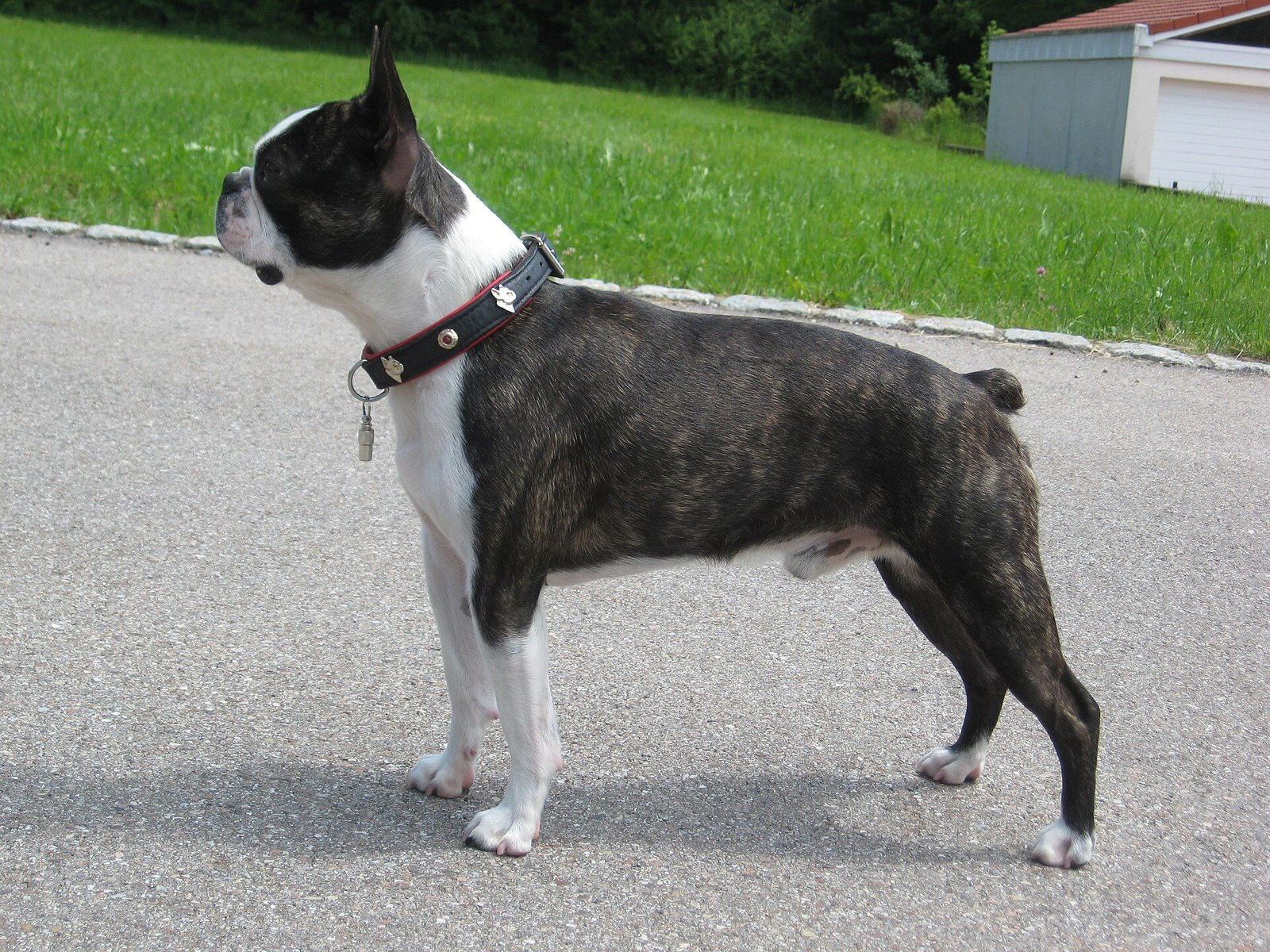
The Boston Terrier has a compact, roughly square outline, upright ears, a short tail, and a smooth coat. The AKC standard describes brindle, seal, or black with white markings; seal can look black until bright light reveals a reddish cast. Those descriptions concern the show standard, not a medical test. Neither a fashionable color nor a textbook pattern proves ancestry, hearing, temperament, or health. The prominent eyes deserve protection from branches, rough play, and rubbing. A short muzzle is an anatomical feature with potential welfare consequences, not a reason to regard snorting or struggling for breath as entertaining.
Standard weight classes are not feeding goals. The AKC divides weight into under fifteen pounds, fifteen to under twenty pounds, and twenty through twenty-five pounds. It does not give separate male and female weight ranges, and the first class has no stated lower limit. PetMD's descriptive adult range of twelve to twenty-five pounds, approximately 5.4-11.3 kilograms, is different from those class boundaries. Actual individuals can fall outside a typical published range; that alone does not establish obesity, underweight, or pedigree. Your veterinarian should assess ribs, waist, muscle, growth, and medical history before recommending a target. Never fatten a small Boston to reach a class or restrict a larger-framed dog simply to fit a chart. Extra fat can worsen breathing, while a low scale reading does not rule out nutritional or muscle loss problems.
Photo credits: Pacamah (CC BY-SA 4.0), Andreas Schlaugat (CC BY 3.0), Jonmills5045 (CC BY-SA 4.0), Slash63 (CC BY-SA 4.0). Images resized and compressed for web display. Each image retains its linked license.
A suitable Boston household offers company, secure outdoor access, comfortable rest, and the flexibility to change plans when breathing or weather makes an outing unsuitable. Use short, comfortable opportunities to sniff and explore rather than a fixed mileage target. Warmth, humidity, excitement, and excess body fat can compound airway problems, so schedule activity around conditions and the individual. Noisy breathing is information to discuss with a veterinarian, not a cute breed soundtrack. Worsening effort, collapse, or blue or gray gums requires immediate veterinary care. Do not wait for a dog to stop wanting its ball before deciding that the game should end.
Daily life also includes measured complete food, fresh water, gentle coat and mouth care, and checks for eye discomfort or altered movement. A red, squinting, cloudy, or suddenly weeping eye needs prompt assessment because a corneal injury can worsen quickly. Ask about patellar examination, specialist eye screening, and documented hearing assessment when reviewing health records; screening does not guarantee unaffected offspring. Water access needs real barriers and close control: neither the breed name nor a flotation aid guarantees safe swimming. Plan gradual alone-time practice, backup care, and a sitter who recognizes respiratory distress. In family homes, adults remain responsible for supervision and give the dog a protected retreat. Related breeds below are comparisons to explore, not promises that their health needs or household suitability match a Boston's.
At a Glance
Ownership Guide
Offer comfortable sniffing walks and low-impact play, adjusted for health, age, weather, and recovery. Use a well-fitted harness and stop before fatigue; noisy or effortful breathing deserves veterinary assessment, not conditioning through distress.
Choose a complete diet appropriate for the dog's life stage, measure portions, and count training rewards. Use veterinary body-condition and muscle assessment rather than aiming for an AKC weight class, because excess fat can worsen breathing.
Brush the short coat gently, inspect ears and nails, and build cooperative tooth brushing. Check eyes daily; squinting, redness, cloudiness, or sudden discharge needs prompt veterinary care, not cosmetic wipes or leftover drops.
Reward calm greetings, toileting outside, harness cooperation, and settling on a mat in small achievable steps. Never use painful equipment or forced exertion; investigate pain, breathing difficulty, and hearing when responses change.
Offer positive, optional experiences at a distance where your dog remains comfortable rather than forcing meetings. Supervise children actively, protect resting spaces, and introduce other animals through controlled, gradual sessions with separation available.
Discuss airway function, eye health, patellar examination, BAER hearing assessment, and individualized preventive care. Obtain actual screening reports when choosing a dog; normal results reduce uncertainty but cannot guarantee lifelong health or unaffected offspring.
Wellness
Short-faced anatomy can restrict airflow. Persistent snorting, snoring, noisy breathing at rest, exercise intolerance, or disrupted sleep warrants assessment; sudden severe effort, blue or gray gums, or collapse requires immediate emergency care.
Heat, humidity, excitement, and exercise can overwhelm a Boston's ability to cool. Stop activity, move the dog somewhere cool, and begin gentle cooling with cold tap water on the body while you contact the emergency veterinarian; suspected heat illness, weakness, or worsening breathing needs immediate veterinary care. Do not delay cooling to wait on the call, and never force food, water, or medicines into a distressed or struggling-to-breathe dog.
Prominent eyes are vulnerable to injury and ulceration. Squinting, rubbing, redness, sudden discharge, or cloudiness needs prompt veterinary assessment; do not wait overnight or use unprescribed eye medicines.
A slipping kneecap can cause intermittent skipping, altered gait, or pain, but other disorders can look similar. Ask for patellar examination and screening records; persistent lameness or inability to bear weight needs prompt care, not home manipulation.
Boston Terriers can have congenital deafness, and later hearing changes have other possible causes. BAER tests auditory responses objectively; reacting to a noise does not prove hearing in both ears, and markings cannot diagnose hearing status.
Cataracts, dry eye, and glaucoma are among reported breed concerns. Discuss specialist eye examinations and relevant hereditary-cataract DNA testing; a clear result for one variant does not exclude every eye disease or replace examination.
Track weight, comfortable activity, sleep, eye appearance, and gait, and review prevention with your veterinarian. Breed predisposition is not a diagnosis, while screening and good care do not guarantee unaffected offspring or prevent every illness.
Further Reading
Build a Boston Terrier care routine around comfortable breathing, cool spaces, gentle activity, daily checks, and practical plans for a safe, settled home.
Read articleChoose a complete diet for your Boston Terrier, judge portions by body condition, manage training treats, and recognize feeding changes that need a vet visit.
Read articleRecognize Boston Terrier breathing, eye, knee, and hearing concerns, understand screening limits, and learn which changes call for urgent veterinary attention.
Read articleTeach your Boston Terrier useful everyday skills with reward-based practice, calm greetings, safe social experiences, and gradual support for time spent alone.
Read articleKeep Boston Terrier grooming gentle with short-coat care, comfortable nail trims, dental habits, and eye checks that separate cleaning from urgent vet care.
Read articleExplore life with a Boston Terrier, from apartment setup and family boundaries to alone time, travel planning, and adapting care as your companion grows older.
Read articleYou May Also Like


