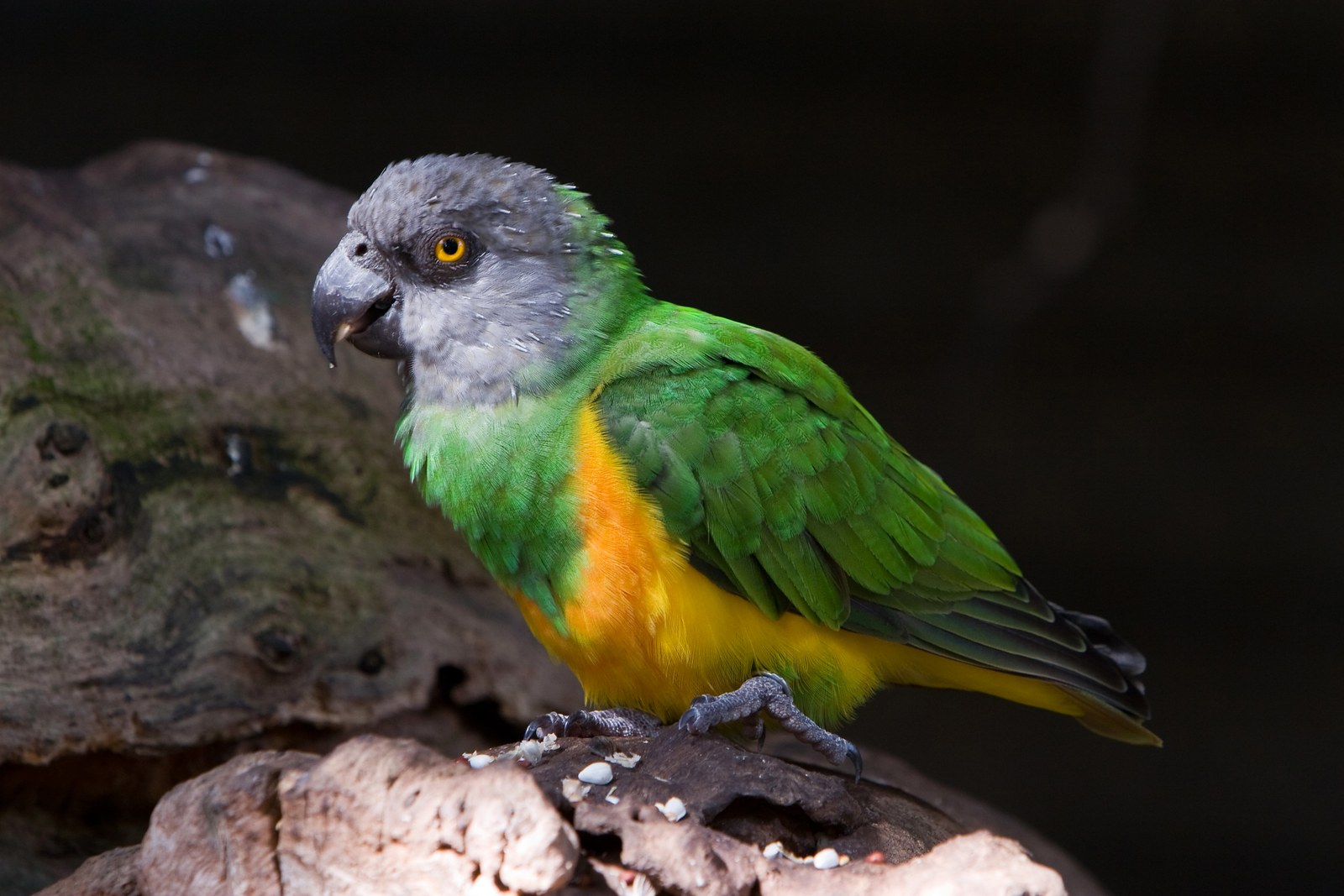
Senegal Parrot grooming is mostly about supporting what a healthy bird already does: preening, bathing, chewing, and moving on suitable surfaces. It is not a schedule of cosmetic clipping, shampooing, or polishing. The gray head and green-and-gold plumage can make changes noticeable, but appearance alone cannot establish health. Your role is to provide safe choices, maintain clean surroundings, observe changes, and recognize when a problem requires an avian veterinarian rather than a grooming tool.
Watch normal preening without turning it into a chore
During preening, a Senegal works through its feathers with the beak, arranging them and maintaining their condition. The bird may spend focused periods doing this, then resume eating, playing, or resting. Learn its ordinary pattern before assuming that every feather touched by the beak indicates plucking. Context matters: repeated chewing in one location, skin injury, or a sudden change in frequency deserves more attention than a familiar relaxed routine.
A hands-off observation habit is useful. Check the bird's outline, wing carriage, tail condition, and comfort while it moves between perches. Notice whether new wear corresponds to a cramped route, a rough fitting, or a favored toy. Correct an obvious environmental hazard, but do not assume that doing so explains every feather problem. Take clear photographs when practical and keep notes for the veterinarian. Avoid repeatedly catching the bird to inspect it; escalating restraint can make future necessary handling harder and does not replace a proper examination. Treat observation as a brief part of daily care rather than a search for cosmetic perfection. Compare changes with your own bird's previous appearance, not an edited photograph or another Senegal with different coloration. A tidy-looking bird still needs routine health monitoring, and a few naturally shed feathers do not by themselves demand intervention.
Offer bathing that the Senegal can control
World Parrot Trust includes shallow bathing bowls and misting among suitable Senegal enrichment options. Offer a stable shallow dish of clean plain water with secure footing, or try a gentle mist only if the bird responds comfortably. Begin at a distance and keep spray away from the face. Some Senegals spread their wings and participate readily; others prefer watching or using a different method. Refusal is information, not a problem to overcome by soaking the bird.
Choose a comfortably warm, calm location and leave enough time for natural drying before the household settles for the night. Avoid drafts, direct heaters, and hair dryers. The bird should be able to move away rather than remain trapped in water or spray. Empty and clean the bathing dish afterward instead of allowing it to become a standing contaminated water source. Bathing frequency should follow the individual, conditions, and any veterinary advice, not a rigid promise that every Senegal requires the same number of baths each week.
Distinguish molt from feather damage
Molt is the replacement of feathers, and its timing in captivity can vary with the environment and the bird's condition. You may find shed feathers and notice developing feathers enclosed in protective sheaths. These growing feathers can be sensitive. Let the Senegal manage its own plumage; if it normally solicits gentle head contact, stay attentive to withdrawal and never squeeze or pull a developing feather.
A bird should still be assessed if feather changes accompany reduced appetite, weight loss, unusual sleepiness, skin lesions, or altered behavior. Bald areas, persistent breakage, bleeding, or repeated damage are not automatically normal molt. Medical and behavioral contributors can overlap, so avoid diagnosing stress simply because a household event occurred recently. A sound diet, predictable rest, and appropriate enrichment support normal care, but none is a guaranteed treatment for feather loss. Do not add supplements, oils, or commercial feather sprays on the assumption that new plumage must need an extra product.
Use perches and cleaning to protect feet
Feet do daily work as a Senegal climbs, balances, holds food, and lands. Provide stable perches with suitable variation in diameter and texture, arranged so the bird can choose positions without awkward repeated jumps. Use only verified bird-safe wood and construction. An unknown outdoor branch may carry chemical contamination or come from an unsuitable plant, so do not treat every natural object as automatically safe.
Check the enclosure methodically during cleaning:
- Remove droppings and food residue from frequently used surfaces.
- Replace cracked, unstable, splintering, or heavily damaged perches.
- Inspect toy attachments for loose fibers and trapping gaps.
- Keep food and drinking containers out of the line of droppings.
- Rinse cleaned items thoroughly and return them only when safe to use.
Avoid sandpaper perch sleeves and other abrasive surfaces promoted as automatic nail solutions. Foot sores, swelling, repeated shifting, or reluctance to grip need veterinary attention. A bird that cannot stand comfortably also needs prompt guidance on safe housing while awaiting examination rather than being made to use a difficult perch.
Leave beak and nail procedures to qualified care
A Senegal's strong beak is a tool for eating, climbing, and investigation. Suitable chewing materials support normal behavior, but they do not justify ignoring sudden overgrowth, asymmetry, cracks, or difficulty eating. The MSD Veterinary Manual notes that healthy birds with appropriate surfaces rarely need beak trimming. An abnormal beak can reflect an underlying issue, so repeated cosmetic adjustments without assessment may miss the actual problem.
Nails also affect grip and stability. Whether an individual needs professional adjustment depends on growth, surfaces, mobility, and health, not merely how sharp the tips feel on a person's skin. Ask an avian veterinarian to assess them. Do not use household clippers or a powered tool to experiment, and do not restrain a struggling Senegal to follow an online demonstration. Live tissue, blood vessels, heat injury, and the effects of restraint make this more than a cosmetic task. Voluntary carrier and perch-transfer training are safer owner contributions because they help the bird reach skilled care with less distress.
Protect flight and respond safely to contamination
Wing clipping is not routine feather maintenance. Flight is natural exercise, and clipping does not reliably prevent escape or eliminate collisions. Discuss any individual medical or mobility concern with an avian veterinarian instead of applying a standard trim to every Senegal. Regardless of feather condition, secure doors and windows, stop fans, protect glass, remove open water, and separate other animals before out-of-cage activity.
Avoid routine shampoos, oils, fragrances, and human grooming products. A bath should use plain water unless a veterinarian prescribes otherwise for a specific condition. Keep cleaning sprays and fumes away from the bird as well as its feathers. Effective feather care is a quiet system of observation and prevention: a Senegal with clean resources, appropriate food, safe movement, and timely veterinary support has no need for an elaborate cosmetic routine.
Continue reading: Living With a Senegal Parrot: Shared Routines and a Plan for the Future.
Sources and further reading:
- World Parrot Trust: Senegal Parrot
- MSD Veterinary Manual: Management of Pet Birds
- MSD Veterinary Manual: Feeding a Pet Bird
- MSD Veterinary Manual: Household Hazards for Pet Birds
- MSD Veterinary Manual: Reproductive Diseases of Pet Birds
Photo credits: Arjan Haverkamp (CC BY 2.0 Generic). Images resized and compressed for web display. Each image retains its linked license.
