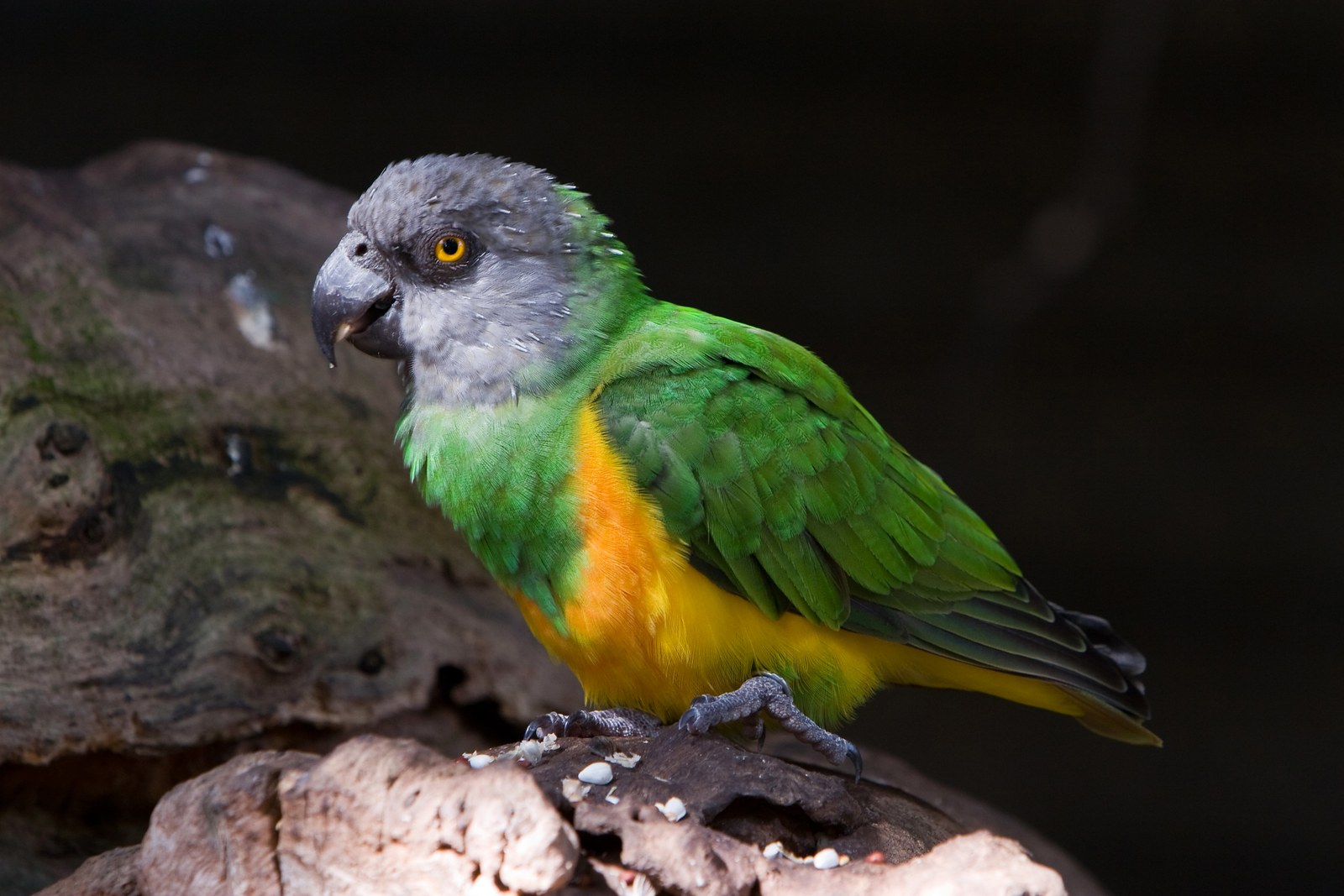
Senegal Parrot training works best when it improves everyday life for both bird and caregiver. The aim is not a parrot that permits anything, but one that understands invitations, can decline safely, and has useful ways to cooperate. A Senegal may form strong individual preferences, investigate with its beak, or protect a favored location. None of those tendencies justifies dominance techniques, forced handling, or promises that every bird will eventually talk or enjoy touching.
Observe the individual before choosing the lesson
Start by watching your Senegal in situations that do not demand interaction. Which distance from a person feels comfortable? Does the bird approach the front of the enclosure, continue eating, or move away? Look at the whole sequence rather than assigning one fixed meaning to a single gesture. Changes in eye pupils, feather position, posture, and movement require context; excitement does not always mean willingness to be touched.
A new or rescued bird may need predictable routines before it can participate comfortably. Make the environment understandable: approach visibly, avoid cornering, and allow retreat. If a previously relaxed Senegal suddenly objects to handling, consider pain, illness, fatigue, or environmental changes instead of assuming defiance. A veterinary examination belongs early in the response to an unexplained behavior change. Training cannot resolve a painful foot or a medical cause of irritability by making the bird comply.
Make a reward marker meaningful
Positive reinforcement means that a consequence the bird values follows a behavior and makes that behavior more likely. Choose a short spoken marker such as good, or a quiet click if the sound does not frighten the bird. Pair the marker with a small suitable reward so it predicts something worthwhile. The reward might be a tiny food piece, access to a toy, or a preferred activity, depending on the individual.
Work while the Senegal is alert and comfortable, not desperately hungry. Keep ordinary food available and include food rewards in the overall diet. Begin with a behavior already happening, such as calmly remaining on a perch as you approach at a comfortable distance. Mark the moment and deliver the reward without moving closer than the bird can tolerate. Several easy successes followed by a break are more useful than a long session that ends with escape or biting.
Teach targeting and stationing in small steps
For targeting, introduce a safe object that the bird can touch gently with its beak. Present it at an easy distance without poking, pursuing, or placing it against the bird. Reward looking toward it, then leaning or moving voluntarily closer, and finally a light touch. If the object causes alarm, return to an earlier step or use a less concerning target. Remove it between repetitions so the invitation remains clear.
Turn this into practical movement rather than endless trick repetition:
- Reward a comfortable target touch on a familiar perch.
- Move the target slightly so one easy step reaches it.
- Guide the bird toward a stable designated perch without blocking retreat.
- Reward remaining there briefly while you stand nearby.
- Build duration and gentle distractions separately, returning to easier work when needed.
This designated place is a station. A Senegal that voluntarily stations away from a bowl door can participate in daily care without a hand entering its personal space. Do not make stationing a demand to freeze while something frightening happens.
Replace forced step-ups with usable alternatives
A step-up can begin with a stable handheld perch if hands are worrying. Present it where the bird can choose to approach, reward investigation, and build toward one foot and then two. Avoid pushing into the chest, tipping the current perch, or repeatedly pursuing the bird around the enclosure. Those methods remove choice and can teach that the offered object predicts discomfort rather than safe transport.
Carrier training follows the same logic. Let the Senegal inspect a secure open carrier in a calm setting, reward approaching, then entering, and only later briefly closing the door. Practice before a veterinary emergency. Keep the carrier steady and check that its perch and fittings are appropriate for the individual. If a real emergency arrives before training is complete, seek the clinic's handling instructions; do not delay necessary treatment while trying to finish a lesson.
Respond to biting and selective bonds without punishment
A bite often has a preceding sequence: a hand enters a guarded space, the bird leans away, the hand continues, and the bird escalates. Record what occurred before and after rather than labeling the Senegal mean. Change the setup so retreat works and reward a safer alternative, such as moving to a station. If a bite happens, protect yourself and give space calmly. Do not shout, strike the beak, spray water, shake a perch, or punish with darkness.
When one person is favored, let others build separate low-pressure relationships. A second adult can deliver a bowl, offer a reward at a comfortable distance, or invite a perch transfer without demanding cuddles. Keep faces and shoulders out of reach during uncertain interactions. Children should observe or participate only in carefully controlled activities with a responsible adult, never test whether a bird is friendly. Equal access to affection is not a fair training goal; safe, predictable care is.
Train for real life while keeping physical safeguards
Practice return-to-cage behavior when there is no hurry. Reward entry and sometimes offer another enjoyable activity afterward, so returning does not always predict the immediate end of interaction. Build comfortable independent play with simple foraging and safe chewing while you remain nearby, then increase distance gradually. A favorite person should be able to leave the room without every departure becoming either a crisis or a prolonged farewell ritual.
Expect progress to vary with health, context, and experience. Maintain skills with easy rewarding repetitions, and simplify after a move or frightening event. Speech is optional, touching is optional, and no training schedule guarantees either. A Senegal that willingly enters a carrier, accepts another caregiver nearby, and returns to a safe perch has learned skills that genuinely protect its welfare.
Continue reading: Senegal Parrot Feather Care: Bathing, Molt, Feet, and Beak Health.
Sources and further reading:
- World Parrot Trust: Senegal Parrot
- MSD Veterinary Manual: Management of Pet Birds
- MSD Veterinary Manual: Feeding a Pet Bird
- MSD Veterinary Manual: Household Hazards for Pet Birds
- MSD Veterinary Manual: Reproductive Diseases of Pet Birds
Photo credits: Arjan Haverkamp (CC BY 2.0 Generic). Images resized and compressed for web display. Each image retains its linked license.
