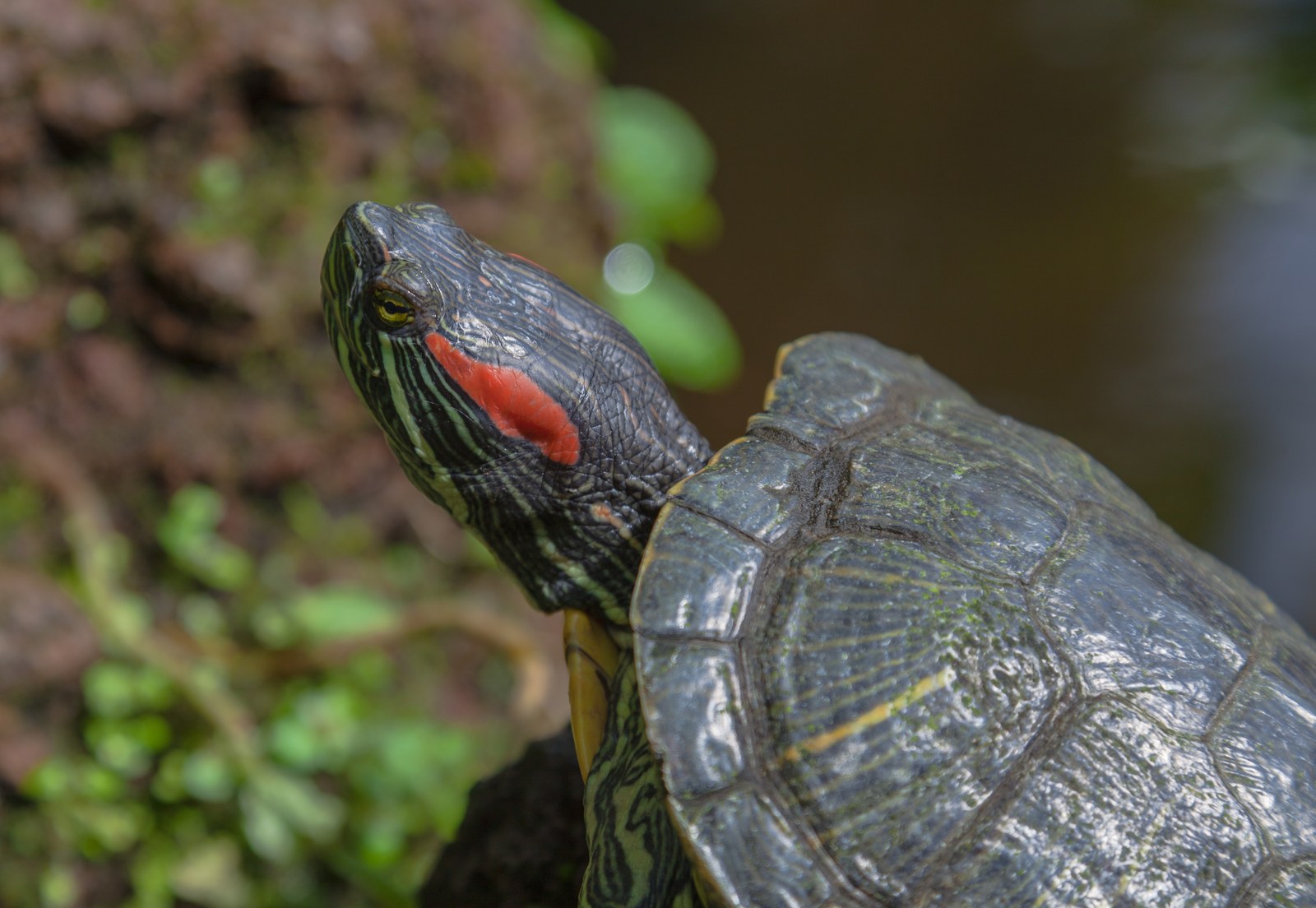
A red-eared slider care guide should begin with the adult turtle, not the tiny animal in a shop display. These semi-aquatic reptiles need room to swim, a completely dry basking area, and equipment that keeps working between feeding days. Set up and test the habitat before acquisition. A thoughtful start prevents the expensive cycle of replacing one undersized tank with another while the turtle keeps growing.
Plan adult swimming space before buying equipment
Actual water volume means the water present after allowing for the dock, furnishings, and escape-prevention space above the waterline. A large number printed on an aquarium is not necessarily usable swimming volume. Choose a broad footprint with unobstructed turning room, secure supports, and a route to the surface that cannot trap a turtle behind equipment.
Published recommendations disagree. RSPCA gives 80 litres per 5 cm of shell length. The Bio Dude describes an adult enclosure offering at least 120–175 gallons of water, while also giving a separate 20-gallons-per-inch rule that can imply larger housing. This guide selects 175 US gallons, about 660 litres, as an adult planning floor, not a universal minimum or a claim that those formulas agree. Larger females or restricted layouts may require more. Confirm floor loading and stand suitability before filling anything.
Plan for one turtle. Additional sliders do not simply share the same allowance, and avoiding competition is easier than treating injuries later.
Build a dock that stays completely dry
A basking platform must support the turtle's entire body above the water. It needs a stable approach, a surface that offers traction without abrasion, and an easy retreat into water. Check performance with the adult's weight in mind: a floating island that supported a juvenile may sink or tilt later.
Arrange the enclosure so the turtle can choose exposure or shade without getting stuck. Secure heavy furnishings, protect heater cables, and avoid narrow openings where the shell can wedge. Small loose objects that could be swallowed add unnecessary risk. Leave maintenance access so you can remove debris without dismantling the habitat every time.
Ventilate the airspace rather than sealing in damp air. This is not a terrestrial lizard enclosure: a moist shedding box cannot replace clean water and a genuinely dry dock.
Measure air, surface, water, and UVB separately
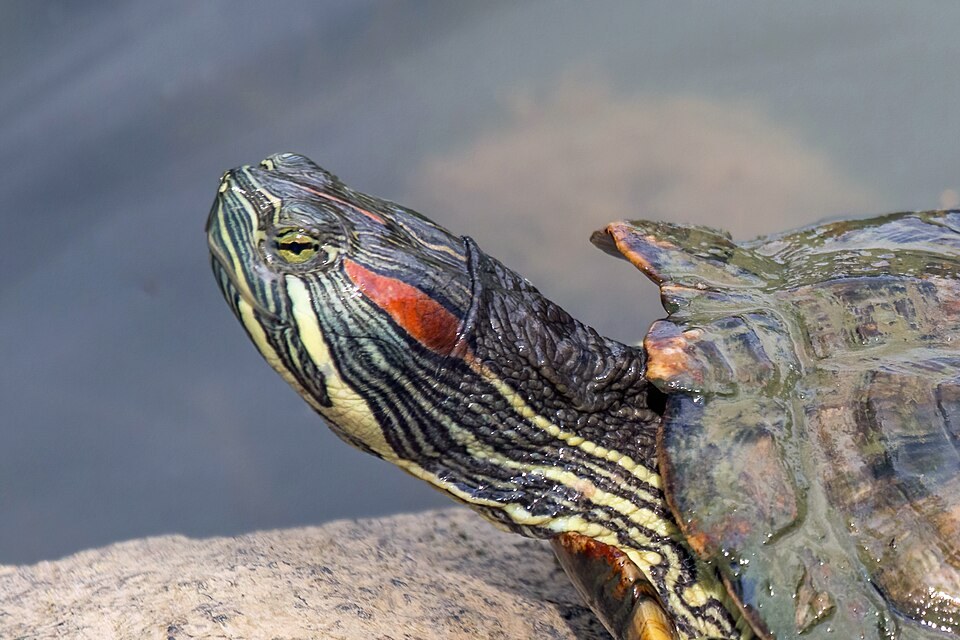
The Bio Dude distinguishes basking air at 85–90°F, or 29.4–32.2°C, from platform surface at 95–104°F, or 35–40°C. Use an air probe for the former and an infrared thermometer on the accessible platform for the latter. Neither tells you the water temperature. RSPCA's separate 30–35°C basking-zone figure does not identify air versus surface, so it must not be repackaged as a surface target.
For water, The Bio Dude lists 74–76°F, approximately 23.3–24.4°C. RSPCA instead specifies about 25°C for hatchlings, decreasing to 22°C for adults. Choose a documented, age-appropriate plan with your reptile veterinarian rather than averaging sources or applying an adult setting to an unwell youngster.
RSPCA recommends basking UVI 3–5, declining to zero in shade. Measure at shell height with a suitable UVI meter and follow the fixture's instructions. A warm bulb is not proof of UVB output. Turn basking lights off at night, while maintaining filtration and appropriate water conditions; this source provides no numerical nighttime air target.
Make filtration part of a maintenance system
Sliders put a substantial waste load into water. The Bio Dude recommends a canister-style filter rated for two to three times the actual water volume. That is a capacity recommendation, not a claim that the source specifies two or three complete tank turnovers per hour. Select equipment for the real enclosure and keep intakes protected.
Biological filtration depends on established beneficial bacteria, as RSPCA explains. Newly installed equipment is not instantly mature. Learn to test ammonia, nitrite, and nitrate, follow an aquatic-system cycling plan, and seek help if waste readings appear. Clear water alone does not establish safety.
- Remove uneaten food and visible waste promptly.
- Test water regularly and record changes over time.
- Prepare replacement water appropriately for your supply and avoid abrupt temperature changes.
- Maintain filter media according to instructions without destroying the entire biological colony at once.
The Bio Dude's 30% weekly water change is a useful attributed starting schedule, not permission to ignore test results or postpone a needed change.
Establish a routine you can keep
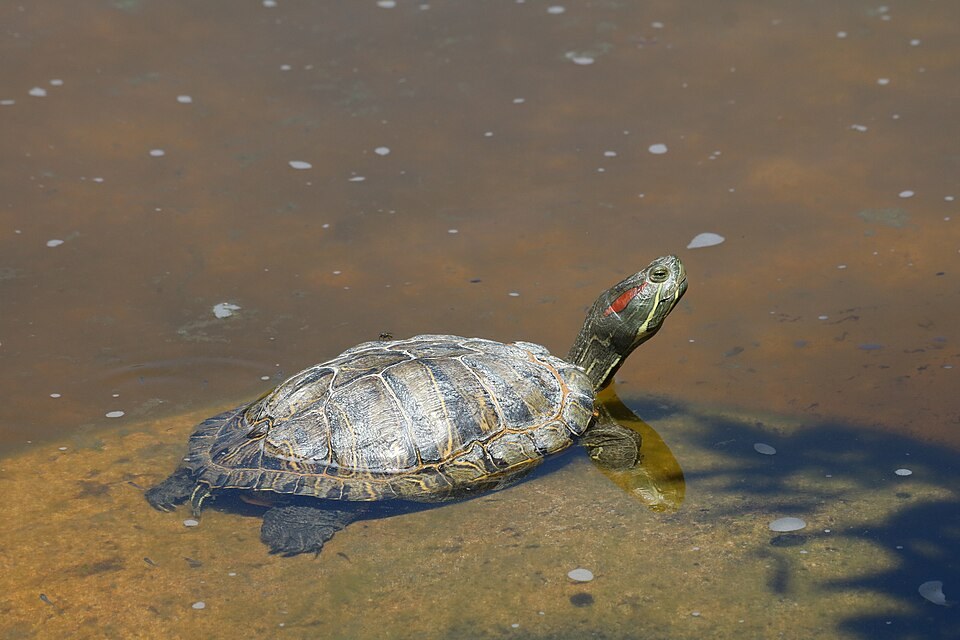
Observe your turtle before touching the enclosure. Note whether it swims normally, climbs onto the dock, breathes comfortably, and responds as usual. Check water temperature and equipment function daily, and inspect the basking area after adjustments. Keep lamp replacement records because visible light does not confirm adequate UVB.
Offer an age-appropriate aquatic-turtle diet rather than dried shrimp alone. Younger sliders generally need more animal foods, while adults shift toward vegetation. Feed where the animal can swallow in water, remove leftovers, and track body condition instead of rewarding every excited approach with food.
Watch for closed or swollen eyes, breathing difficulty, new swimming problems, and shell damage. Contact a reptile veterinarian rather than trying to fix every symptom by increasing heat or adding vitamins. Preventive appointments also help establish an individual baseline before an emergency forces rushed decisions.
Protect the household and the wider environment
Treat the turtle, water, and equipment as possible Salmonella sources. CDC recommends handwashing after contact and keeping habitat cleaning out of food-preparation areas. Children under five should not handle reptiles or their environments; older adults and immunocompromised people also face increased risk.
Check current local ownership and transfer rules before acquiring one. RSPCA reports captive lifespans as long as 30–40 years, so reliable care may outlast several homes, jobs, and family routines. Budget for replacement equipment, veterinary visits, and a trained backup keeper. If you cannot meet the adult plan now, postponing acquisition is kinder than relying on an unspecified future upgrade.
Continue reading: Red-Eared Slider Feeding: A Practical Life-Stage Diet Plan.
Sources and further reading:
- RSPCA: How to care for a terrapin
- The Bio Dude: Red Ear Slider Care and Maintenance
- CDC: Reptiles and Amphibians
- USGS NAS: Red-eared Slider Species Profile
- 21 CFR 1240.62: Turtles intrastate and interstate requirements
Photo credits: Diego Delso (CC BY-SA 3.0), Charles J. Sharp (CC BY-SA 4.0), Grendelkhan (CC BY-SA 4.0). Images resized and compressed for web display. Each image retains its linked license.


