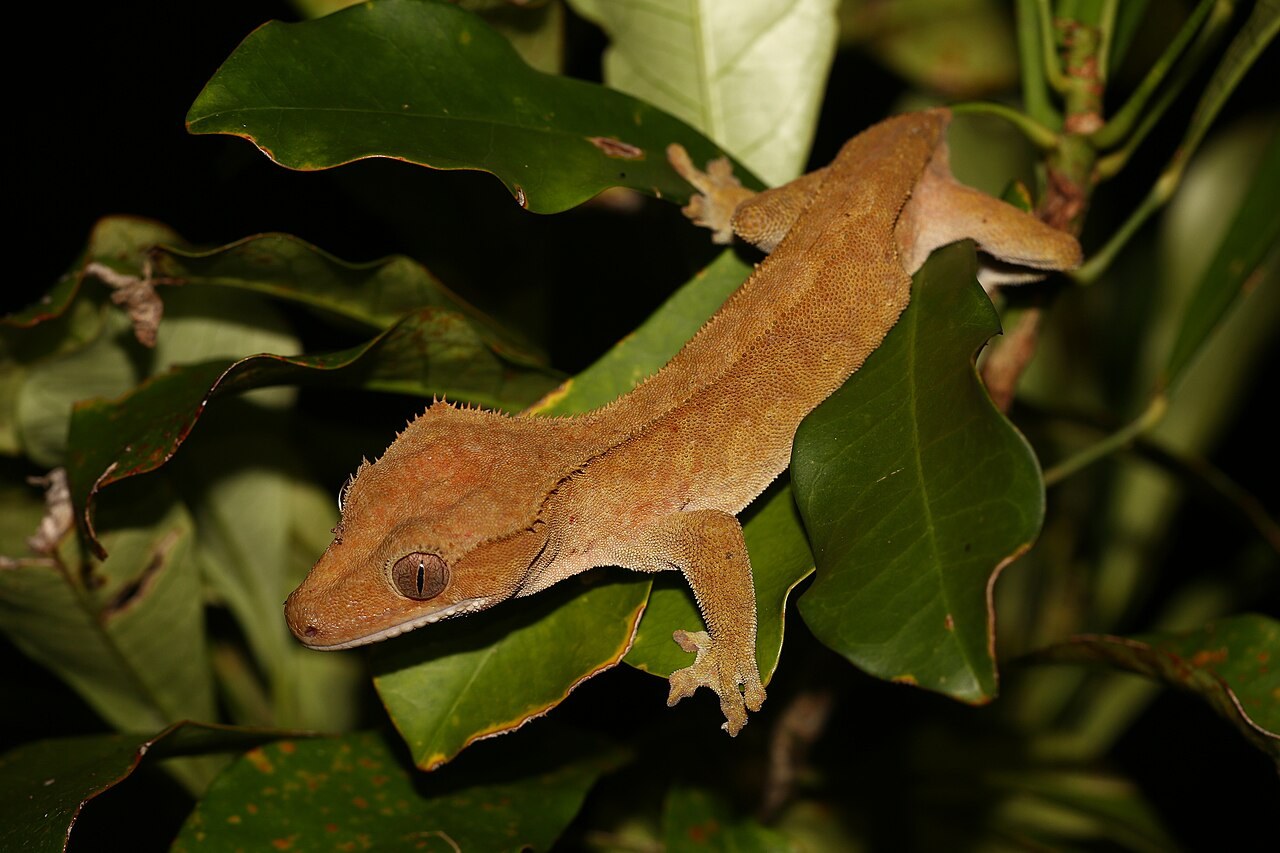
Crested gecko care works best when you build a habitat around choices: climbing routes or cover, gentle warmth or a cooler perch, droplets after misting or a dry resting surface later. This New Caledonian lizard is not a miniature desert reptile. Its small size does not remove the need for a substantial enclosure, accurate instruments and a plan for hot weather.
Choose a genuinely usable upright enclosure
For one adult, use at least 18 × 18 × 36 in (45.7 × 45.7 × 91.4 cm), length by width by height. This is the upright care baseline used here, not a universal legal minimum. More usable space is preferable, particularly for a large or active individual. A low aquarium with the same approximate volume does not provide an equivalent climbing environment.
Secure branches both diagonally and horizontally, connect them with foliage and include broad resting places. The gecko should be able to move between feeding, shelter and warmth without repeatedly crossing an exposed gap. Leave routes that you can inspect and clean. Plants must be suitable for reptile housing and free of pesticide residues; artificial plants also need secure attachments and washable surfaces.
Check door gaps, cable ports and mesh seams before occupancy. Keep cats and other pets away from the enclosure. House geckos separately: competition can occur before you notice obvious fighting, and a pair may breed unexpectedly.
Separate air readings from gentle surface warmth
Aim for warm upper air of 24–26°C (75.2–78.8°F) and cool sheltered air of 21–24°C (69.8–75.2°F). These are practical operating ranges, not the setting for every thermostat. Secure digital probes near occupied perches, away from direct radiant exposure, and compare upper and lower readings. A probe that falls onto damp substrate stops describing the animal's normal resting environment.
Check accessible perch surfaces directly with an infrared thermometer, not through glass, to identify hotspots. RSPCA's warm-zone guidance does not explicitly specify a contact-surface target, so this guide does not convert it into one. A surface reading and an air reading answer different questions. Choose added heat only after measuring the enclosure in its actual room, and control it with an appropriate thermostat. Keep lamps and hot fittings inaccessible.
At night, allow air to fall to 18–20°C (64.4–68°F). If heat is necessary, use a safely installed, thermostatically controlled source that produces no visible light. Colored night bulbs and heat rocks are unsuitable solutions.
Make overheating prevention part of the setup
A room that feels comfortable in spring can become dangerous behind closed windows in summer. Record daily maximum temperatures before leaving the gecko unattended for a workday. Direct sunlight through a window can heat an enclosure rapidly, even when the household thermostat looks reassuring. Move the habitat away from sunny glass before an emergency occurs.
Treat 29°C (84.2°F) as a precautionary intervention threshold for accessible areas, not an acceptable routine target or a precisely measured lethal boundary. Heat stress can occur earlier depending on duration, hydration and available retreat. Turn off unnecessary supplemental heat and improve room cooling if readings climb; a thermostat cannot cool an already hot room.
Keep a ventilated transport container ready, and identify where it could safely remain during a cooling-system failure.
Provide shaded UVB and a predictable day
This guide uses a gentle UVB gradient of approximately UVI 0.7 at the exposed upper perch, falling to zero inside dense shade. Published husbandry schemes differ, so do not combine the highest target from one guide with the closest lamp distance from another. The animal must be able to shelter without losing access to its normal climbing routes.
Measure at the height of the gecko's back, including the highest position it can actually reach. Mesh, reflectors, lamp age and distance all change exposure. Glass or plastic between the lamp and enclosure interior blocks useful UVB. Follow fixture-specific spacing guidance, measure the installed arrangement where possible and recheck after changing branches.
Start with about 12 hours of light and 12 hours of darkness on a timer. Visible lighting supports a predictable daily rhythm; nighttime darkness matters too. UVB does not make a poor diet complete, and dietary vitamin D3 must be considered alongside the lighting plan.
Manage humidity as a cycle rather than a ceiling
Allow a brief rise around 70–80% RH after misting, followed by a daytime drying phase toward 40–50% RH before the next substantial misting. Place a digital hygrometer near occupied perches, outside the direct spray path. A soaked sensor reports the spray event more than the atmosphere the gecko is choosing.
Mist foliage in the evening and adjust further misting to actual conditions. Exposed leaves and the substrate surface should dry between wettings without the entire habitat becoming desiccated. Cross-ventilation is essential; sealing vents to keep a high number on the display can create persistent dampness and poor air exchange.
Provide fresh water daily in a stable, accessible dish even if you see the gecko licking droplets. A clean, sheltered humid refuge can assist shedding, but it should be lightly damp rather than waterlogged.
Test the routine before your gecko arrives
Run the furnished habitat through several complete day and night cycles before introducing the animal. Practice reaching dishes without dismantling its cover. Use a complete commercial crested gecko diet, not baby fruit puree, and prepare it according to its own label. Food belongs on a stable ledge that the gecko can approach under cover.
Your daily checklist should include:
- Review minimum and maximum temperatures and check probe positions.
- Renew drinking water and inspect food for contamination or drying.
- Remove visible waste and check door latches and plant attachments.
- Observe evening movement without repeatedly waking the animal by day.
- Adjust misting to the measured wet and dry phases.
Wash hands after enclosure work and keep reptile equipment outside kitchens. Arrange a baseline reptile-veterinary visit and retain feeding and weight records. Reliable observation, rather than constant handling or elaborate decoration, is what turns a well-equipped enclosure into a stable long-term home.
Continue reading: Crested Gecko Feeding and Nutrition: Complete Diets Explained.
Sources and further reading:
- RSPCA: Caring for your Crested Gecko
- ReptiFiles: Crested Gecko Care Manual and Terrarium Size Guidelines
- ReptiFiles: Crested Gecko Temperatures & Humidity
- ReptiFiles: Crested Gecko Food
- CDC: Reptiles and Amphibians
Photo credits: Lennart Hudel (CC BY 4.0 International). Images resized and compressed for web display. Each image retains its linked license.
