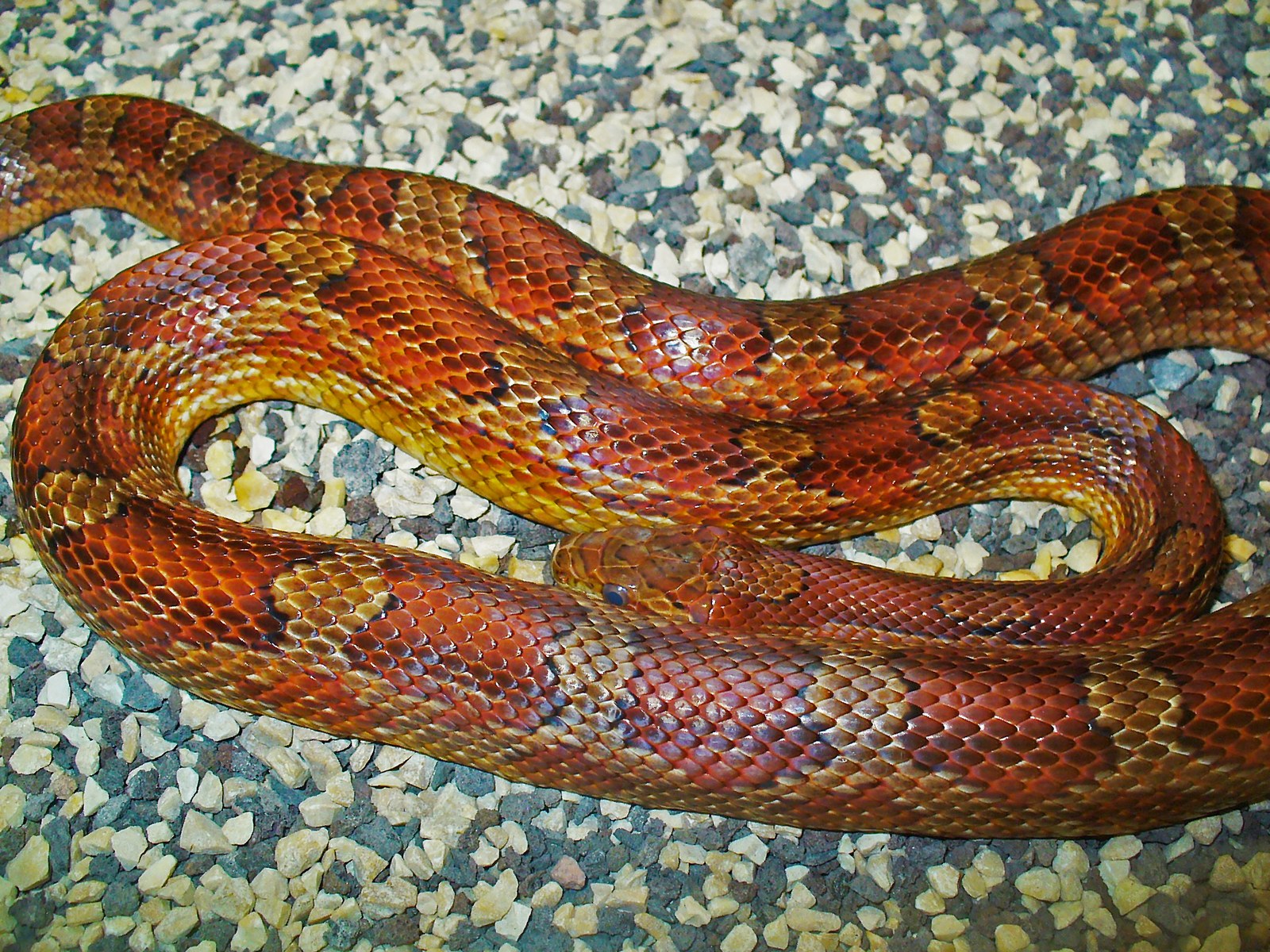
A good corn snake care setup makes the animal's choices easy and your checks reliable. Your snake should be able to stretch out, retreat into cover, climb securely, and move between warmer and cooler areas. Instead of buying a collection of accessories and hoping they work together, build a habitat around those functions. Test the finished enclosure before the snake arrives, then keep a record of what actually happens inside it.
Give your corn snake usable space
Start with an adult enclosure offering 150 × 60 × 60 cm of internal usable space, approximately 59 × 24 × 24 inches. This is a practical recommendation, not a ceiling: the snake must be able to straighten completely along its length. Upgrade for a longer individual. Decorative panels, bulky backgrounds, and thick fixtures can reduce usable dimensions, so check inside measurements rather than relying on the packaging.
Corn snakes are capable climbers as well as ground explorers. Anchor branches so they cannot roll or fall, and provide sheltered routes between snug hides at both ends. A small juvenile can use a larger enclosure when plentiful close-fitting shelters and cover prevent exposure. House only one snake, and inspect sliding-door gaps, cable ports, ventilation panels, and lid clips. A closure that seems adequate for a large adult may still admit a hatchling's head.
Place the enclosure away from direct sun, radiators, and drafts. Consider access for cleaning and whether every household member can secure it correctly. Never depend on a heavy book to hold a lid shut.
Separate air readings from the basking surface
Aim for daytime warm-zone air of 28–30°C, or 82.4–86°F, and cool-zone air of 20–24°C, or 68–75.2°F. These are different positions, not a whole-enclosure setting. Suspend digital thermometer probes just above substrate at the snake's level; keep the cool probe shaded and avoid resting either air probe on a warmed object. Measure elevated resting areas as well.
Provide a basking surface near 32°C, or 89.6°F, checked separately with an infrared thermometer. Its reading describes the surface, not the air above it. Understand the instrument's spot size and distance requirements, and use a suitable surface probe if needed to resolve uncertainty. A thermostat controls equipment; an independent thermometer checks the result. One cannot replace the other.
Use compatible thermostatic control for every heat source and prevent contact with lamps, hot guards, and wiring. For healthy established snakes, routine overnight air of 18–20°C, or 64.4–68°F, is our conservative baseline. Very young or unwell animals need an individual plan rather than automatic adult cooling.
Offer light with genuine shade
Use a consistent 12-hour light period followed by 12 hours of darkness. Position UVB toward the warm end so that light, warmth, and full shade remain available as choices. Following the RSPCA approach, aim for about UVI 1.0 at the basking position and 0 inside fully shaded retreats. Albino animals need lower exposure; the RSPCA gives a basking maximum of UVI 0.7.
Measure at the snake's back height, including the highest accessible perch. A lamp's printed percentage is not the exposure received by your animal: distance, mesh, reflector design, and aging all change output. Glass or plastic between the lamp and snake can block intended UVB. Follow appropriate installation guidance and verify the finished arrangement rather than copying someone else's bulb and distance.
Keep overnight heating separate from lighting if extra heat is necessary. Colored bulbs still produce light and do not provide a dark night. Do not sacrifice a cool shaded retreat just to reach the desired warm-end reading.
Balance moisture with dry resting areas
This guide follows a baseline enclosure humidity around 40–50% RH, together with a humid hide and fresh water. Corn snake recommendations vary across reputable husbandry sources; this is a coherent starting approach rather than a universal number that overrides the animal's condition. A ball python's environmental plan should not simply be copied into this enclosure.
Position digital hygrometers at snake height in representative warm and cool locations, away from splashes. Relative humidity naturally shifts as temperature changes, so compare readings taken at similar times. A brief fluctuation is different from persistently wet, poorly ventilated housing. Keep ordinary resting surfaces dry and the humid hide's lining lightly damp, not dripping. Check it for waste and mold.
Provide a stable water dish and change the water daily or immediately when soiled. Suitable burrowing substrate and cover support natural behavior, but neither eliminates cleaning. Recurrent poor sheds or suspected dehydration deserve a veterinary review of the complete setup, not repeated saturation of all the bedding.
Establish feeding and cleaning routines
Offer appropriately sized, fully thawed pre-killed whole rodents with tongs in the home enclosure. Representative intervals are every 5–6 days for hatchlings, 7–10 days for growing juveniles, and 14–21 days for many adults. Adjust to body condition, growth, and prey size rather than treating enthusiastic feeding as permission for extra meals. Good-quality whole prey usually needs no routine supplement dusting.
Wait at least 48 hours after a meal before handling. Use that quiet period for observation rather than unnecessary rearrangement. Remove waste promptly, clean contaminated furnishings, and follow the instructions on a reptile-safe disinfectant, including rinsing and drying before reuse.
- Check locks, water, and actual environmental readings daily.
- Record meals, refusals, sheds, droppings, and weight trends.
- Keep feeder preparation and reptile equipment outside kitchens.
- Wash hands with soap and water after all care tasks.
Know when habitat changes need veterinary help
A snake repeatedly rubbing its nose, soaking unusually often, or refusing meals may be responding to environmental problems, illness, or both. Check the record and equipment, but avoid changing several variables blindly. Quiet breathing, intact skin, and stable appropriate condition are useful baselines; they do not rule out disease.
Open-mouth breathing at rest, a serious burn, prolapse, collapse, or marked weakness requires urgent reptile veterinary attention. Regurgitation, repeated refusal, weight loss, and retained skin also warrant advice. Do not assume reduced appetite means harmless winter dormancy, particularly in a young snake.
A well-designed enclosure is not finished forever. Recheck it when the snake grows, room temperatures change, or equipment is replaced. Consistent measurement and small, justified adjustments are more useful than chasing a perfect-looking display.
Continue reading: Corn Snake Feeding and Nutrition: Meals Without Overfeeding.
Sources and further reading:
- RSPCA: Corn snake care
- ReptiFiles: Corn Snake Temperatures, Lighting & Humidity
- ReptiFiles: Feeding Your Corn Snake
- Merck Veterinary Manual: Management and Husbandry of Reptiles
- CDC: Reptiles and Amphibians
Photo credits: H. Zell (CC BY-SA 3.0 Unported). Images resized and compressed for web display. Each image retains its linked license.
