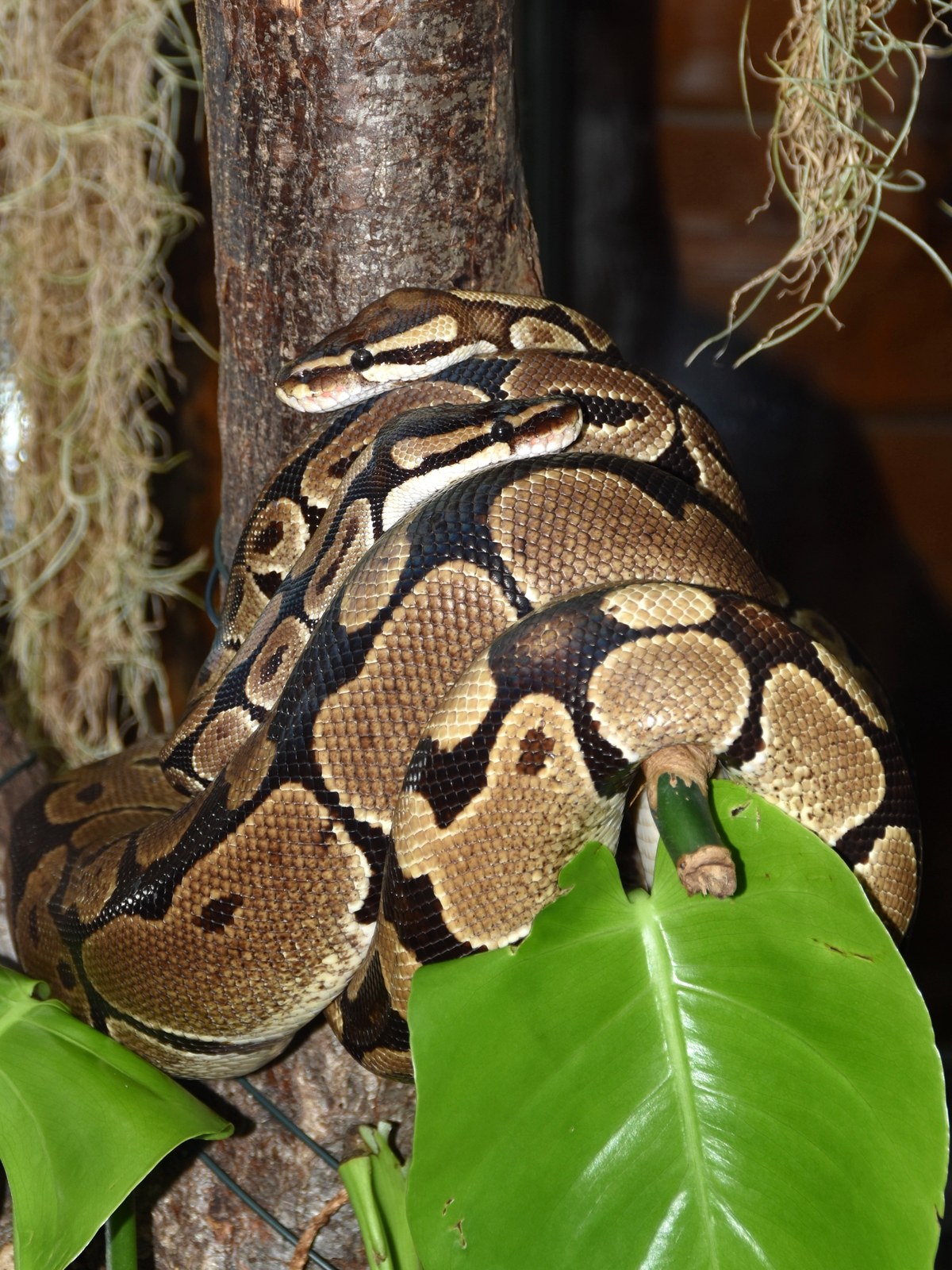
Ball python feeding is not a contest to produce the largest snake quickly. The goal is steady, appropriate development in young animals and a healthy body condition in adults. A useful feeding plan combines whole prey, safe preparation and records that show change over time. It also treats food refusal as information to investigate, not a personality trait that excuses every missed meal.
Choose complete prey rather than fragments
A ball python is a carnivore adapted to swallowing whole vertebrate prey. In captivity, suitably sized pre-killed frozen-thawed rodents are the routine choice. Muscle meat alone, scraps from a human meal and processed pet foods do not reproduce the balance supplied by the skeleton, organs and other tissues of a whole prey animal. Buy feeders from a reputable supplier with clear storage instructions and avoid prey that appears spoiled or has an uncertain thawing history.
Select one rodent approximately the diameter of the snake's widest body region or only slightly wider. This is a practical starting description, not a reason to offer a visibly excessive meal. Supplier labels such as small or medium are not standardized, so record actual prey weight when possible. Match food to the individual rather than copying another keeper's purchase. A stocky adult and a growing juvenile can have very different nutritional needs even when both readily accept food.
Adjust frequency as growth and condition change
Young growing juveniles may start with a meal roughly every 5–6 days. For a healthy adult, around every 14 days is a starting point, with longer intervals appropriate when age, activity and body condition indicate lower needs. Reduce frequency as growth slows rather than carrying a juvenile schedule into adulthood. These intervals are representative planning tools, not a promise that every animal should eat on the same calendar.
Body condition matters more than rapid weight gain. Ball pythons are naturally substantial snakes, but pronounced fat rolls, an abrupt narrowing at the tail or a progressively rounded body may signal excess condition. A sharply prominent spine or declining muscle can indicate the opposite. These observations support, but do not replace, veterinary assessment. Compare serial weights taken on the same scale under similar circumstances, allowing for recent meals and waste passage. Never use breeding goals or a desire for an impressive size to justify power-feeding.
Prepare frozen rodents without contaminating the kitchen
Frozen feeders are not sterile. They can carry organisms hazardous to people even when they are appropriate food for the snake. Store them in sealed, clearly identified packaging separated from human food. Thaw in a dedicated sealed container under refrigeration, away from ready-to-eat items, following supplier instructions. Complete the process in a designated non-kitchen area with equipment reserved for reptile care; never use food preparation surfaces or the kitchen sink.
Once fully thawed, warm the sealed prey gently using warm water and dedicated containers. Check that the center is thawed rather than judging only the outer skin. Do not microwave, cook, use boiling water or leave a rodent unrefrigerated for a prolonged period. Offer it promptly and discard uneaten thawed prey rather than repeatedly warming and refreezing it. Wash hands with soap and water after handling feeders, packaging, tongs or contaminated surfaces, and clean the dedicated preparation area before other household activities resume.
Offer food calmly and protect digestion
Feed inside the secure enclosure, using suitably long tongs rather than fingers to present prey. Moving the snake into a separate feeding box adds handling without being necessary for routine feeding. Offer food when the animal is normally active and keep the room quiet. If it withdraws or remains defensive, avoid repeatedly touching its face with prey. A missed attempt should not turn into an extended session of harassment.
After a successful meal, leave the snake undisturbed and avoid handling for at least 48 hours. Maintain thermal choices: warm-zone air at 30–32°C (86–89.6°F) and cool-side air at 24–26°C (75.2–78.8°F). This plan retains access to that gradient overnight rather than prescribing a blind temperature drop after the lights turn off. Those are air readings, not a hotter surface prescription. If regurgitation occurs, record the event and contact a reptile veterinarian before offering another meal; immediately replacing the lost food can worsen the problem.
Avoid unnecessary powders and nutritional shortcuts
Good-quality whole rodents normally supply the calcium and other nutrients a ball python requires. Routine calcium, D3 or multivitamin dusting is therefore not usually needed. Advice intended for insect-eating lizards should not be transferred automatically to a whole-prey snake. Additional supplements can create imbalances, and more is not inherently safer. If a veterinarian identifies a specific nutritional problem, follow the individualized plan rather than adding several products at once.
UVB provision and nutrition should be discussed together without treating either as a cure for poor husbandry. This care plan offers a low-level gradient up to UVI 1.0 with complete shade, or a lower maximum of UVI 0.7 for albinos. A lamp's printed percentage does not reveal the exposure at the snake's back. Neither UVB nor supplements make inadequate temperatures, spoiled prey or chronic overfeeding acceptable. Review the whole setup when growth or condition deviates from the expected pattern.
Investigate refusal with records, not risky experiments
A ball python may decline food around shedding, after relocation or when conditions are unsuitable, but those possibilities are not automatic diagnoses. Record the refusal and compare weight, body condition, activity and breathing with the animal's baseline. Check actual air readings, surface safety, humidity, hide security, recent handling and prey preparation. Do not assume that a thermostat setting means the enclosure remained warm overnight.
- Note when the last meal was eaten and whether it was retained.
- Verify the scale and record weight consistently without excessive handling.
- Photograph relevant enclosure changes and save temperature records.
- Contact a reptile veterinarian for repeated refusal or concerning changes.
Weight loss, weakness, discharge, abnormal breathing or regurgitation makes assessment more urgent, and a juvenile warrants earlier advice than an otherwise stable adult. Even a stable weight does not prove that an indefinite fast is safe. There is no universal number of missed meals that rules disease out.
Continue reading: Ball Python Health: Warning Signs, Prevention and Vet Care.
Sources and further reading:
- RSPCA: Royal pythons
- ReptiFiles: Ball Python Humidity, Temperature & Lighting Requirements
- MSD Veterinary Manual: Management and Husbandry of Reptiles
- Malformations of the sacculus and the semicircular canals in spider morph pythons
- CDC: Reptiles and Amphibians
Photo credits: NasserHalaweh (CC BY-SA 4.0 International). Images resized and compressed for web display. Each image retains its linked license. The ball python photograph shows two animals in a zoo display, not a recommended home-housing arrangement. House pet ball pythons individually.
