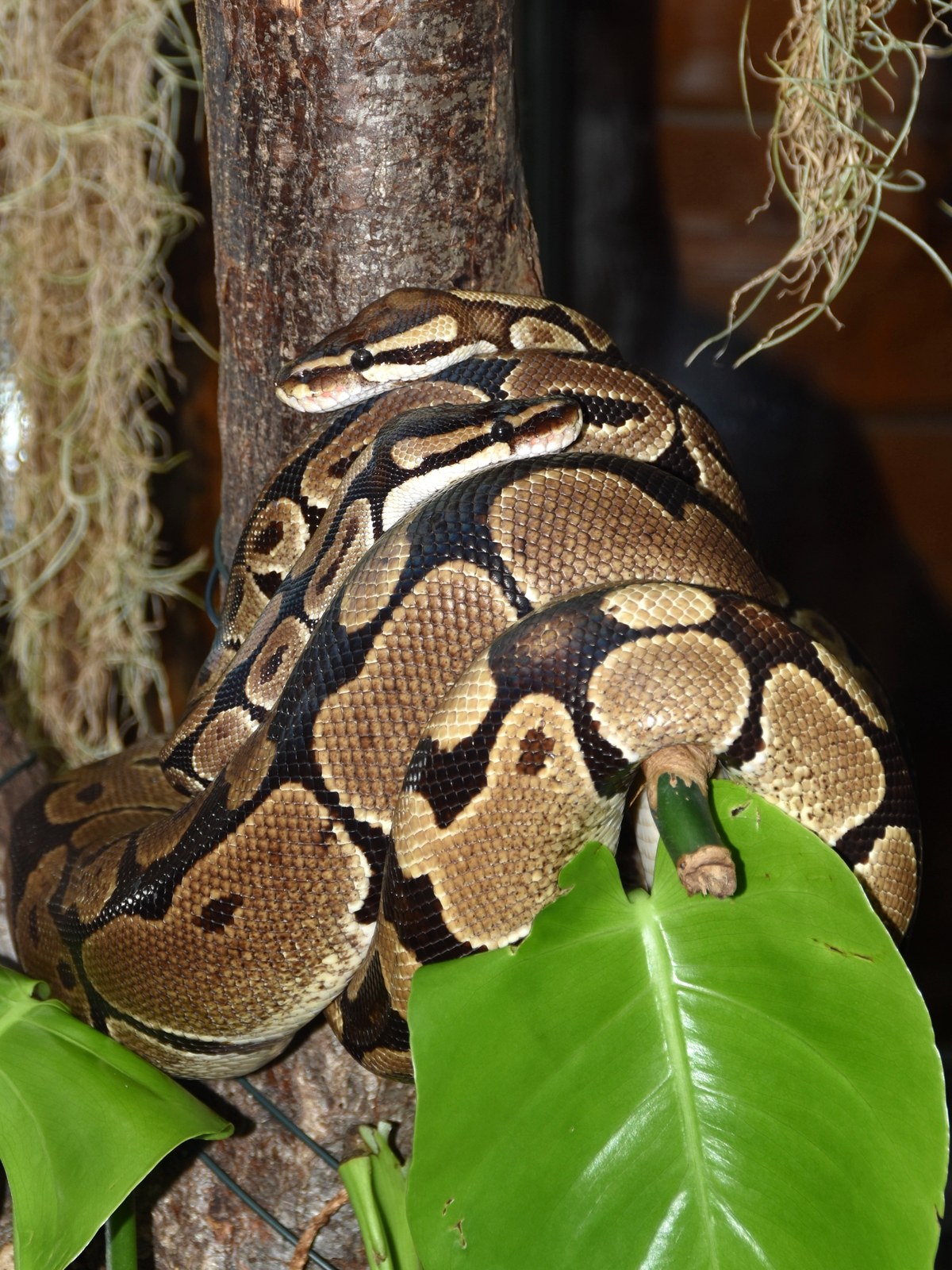
Ball python care starts with choices: somewhere warm, somewhere cooler, somewhere humid and somewhere completely hidden. A snake that curls quietly in a small box is not demonstrating that the box meets its needs. Build the environment around adult size and measurable conditions, then let behavior and health records help you assess whether the setup works.
Give an adult ball python usable space
Start adult planning with a horizontally oriented enclosure measuring 150 × 60 × 60 cm, about 59 × 24 × 24 inches, in length, width and height. This is an editorial starting recommendation, not a universal legal minimum. An adult can reach around 150 cm in total length, and the enclosure's usable straight length must allow full extension. A longer snake needs a longer enclosure, not an explanation that it usually stays curled.
Cover makes space usable. Provide snug hides in both the warm and cool zones so the animal does not have to choose between security and temperature. Add a humid hide, stable branches and visual barriers while keeping a clear route for stretching. Heavy decorations must not shift onto a burrowing snake. Ball pythons can climb and push through small gaps, so inspect sliding doors, cable openings and lid fasteners. House one snake only; hiding together does not prove that two animals are comfortable or compatible.
Measure air and resting surfaces separately
Aim for warm-zone air at snake level of 30–32°C (86–89.6°F), with cool-side air at 24–26°C (75.2–78.8°F). These describe different locations, not a target for the entire enclosure. Use separate digital air probes and check conditions within hides. Keep measurement probes off heated surfaces, and remember that direct radiant heat can affect the probe itself. A thermostat display alone is not an independent measurement.
Use an infrared thermometer to check resting surfaces, branch tops and hide roofs. It does not measure the air between the instrument and the target. This plan does not add a separate hotter surface target to the snake-level warm-zone guidance; do not borrow a lizard's basking figure. Guard accessible heating equipment and use a compatible thermostat with a securely positioned control probe. If a surface becomes unexpectedly hot, prevent access and correct the setup before use. Neither a hot rock nor an unregulated heater is an acceptable shortcut.
Keep nights dark without making them cold
Provide a predictable 12-hour light period followed by 12 hours of darkness. Turning off visible lighting does not mean switching off all heating. This conservative plan retains cool-side air at 24–26°C (75.2–78.8°F) and access to a warm retreat at 30–32°C (86–89.6°F) overnight. Use guarded, thermostat-controlled non-light-emitting heat when needed, and inspect recorded overnight minima rather than guessing from the room's afternoon temperature.
Low-level UVB should form a gradient, reaching up to UVI 1.0 at the exposed resting position and falling to zero in complete shade. For albinos, use the lower maximum of UVI 0.7. Measure at the snake's back height, including any raised route closer to the lamp. Mesh, distance, reflector shape and lamp age alter exposure; a percentage printed on a bulb cannot specify the animal's dose. Glass and plastic barriers make UVB delivery unreliable. Keep shaded retreats available throughout the day, and never use colored night bulbs or forced seasonal cooling.
Balance humidity with a dry contact surface
Aim for 60–80% daytime relative humidity, allowing a natural nighttime rise without trying to force saturation. Different care references use different baseline ranges; this plan uses the specialist daytime band consistently. Position a digital hygrometer around mid-enclosure at snake height and cross-check the cool end. Record the location and temperature because a reading beside a water dish is not interchangeable with one above the warm hide.
Moisture-retentive substrate can hold water below the surface while the exposed layer dries between additions. Keep ventilation functioning and replace dirty wet patches immediately. Humid air and persistently wet belly contact are not the same thing: the latter, especially with contamination, increases skin-disease risk. Provide a clean humid hide with damp rather than dripping material, plus fresh drinking water daily. Repeated soaking, incomplete sheds or skin changes deserve investigation rather than simply more spraying.
Connect feeding, handling and hygiene
Feed suitably sized pre-killed frozen-thawed whole rodents. Young growing juveniles may start around every 5–6 days; healthy adults may begin around every 14 days, with intervals adjusted to age, activity and body condition. These are starting points, not orders to feed an animal that is becoming overweight. Record prey size, acceptance and weight trends. Good-quality whole prey normally supplies the necessary minerals without routine calcium or D3 dusting; discuss exceptions with a reptile veterinarian.
Let a new arrival settle before optional handling, support the whole body and avoid contact during shedding or illness. Wait at least 48 hours after feeding before handling. Clean waste promptly, wash hands after snake or feeder contact, and keep equipment out of kitchens. Healthy-looking reptiles can carry Salmonella, so appearance cannot establish that handling is hygienically safe. Household suitability needs extra consideration when young children, immunocompromised people or older adults are present.
Test the habitat and maintain a useful log
Run the complete enclosure before the snake arrives so you can observe daytime peaks, overnight lows and how moisture changes after routine maintenance. Repeat checks after replacing a lamp, moving a hide, changing substrate depth or experiencing a seasonal room-temperature shift. A setup that worked in summer may need adjustment in winter, even with the same equipment.
- Check the animal, locks, water and visible waste every day.
- Read independent warm and cool thermometers and inspect thermostat probes.
- Record humidity with its location, not just a percentage.
- Check accessible surfaces and retain clear routes into shaded hides.
- Log meals, sheds, weight trends and unusual behavior for the veterinarian.
Arrange reptile-veterinary access and backup care before an emergency. Ball pythons can live beyond 20 years, making reliable routines more important than an impressive first enclosure photograph. A good habitat offers safe choices and produces records you can act on, rather than relying on assumptions about a quiet snake.
Continue reading: Ball Python Feeding: Whole Prey, Body Condition and Refusal.
Sources and further reading:
- RSPCA: Royal pythons
- ReptiFiles: Ball Python Humidity, Temperature & Lighting Requirements
- MSD Veterinary Manual: Management and Husbandry of Reptiles
- Malformations of the sacculus and the semicircular canals in spider morph pythons
- CDC: Reptiles and Amphibians
Photo credits: NasserHalaweh (CC BY-SA 4.0 International). Images resized and compressed for web display. Each image retains its linked license. The ball python photograph shows two animals in a zoo display, not a recommended home-housing arrangement. House pet ball pythons individually.
