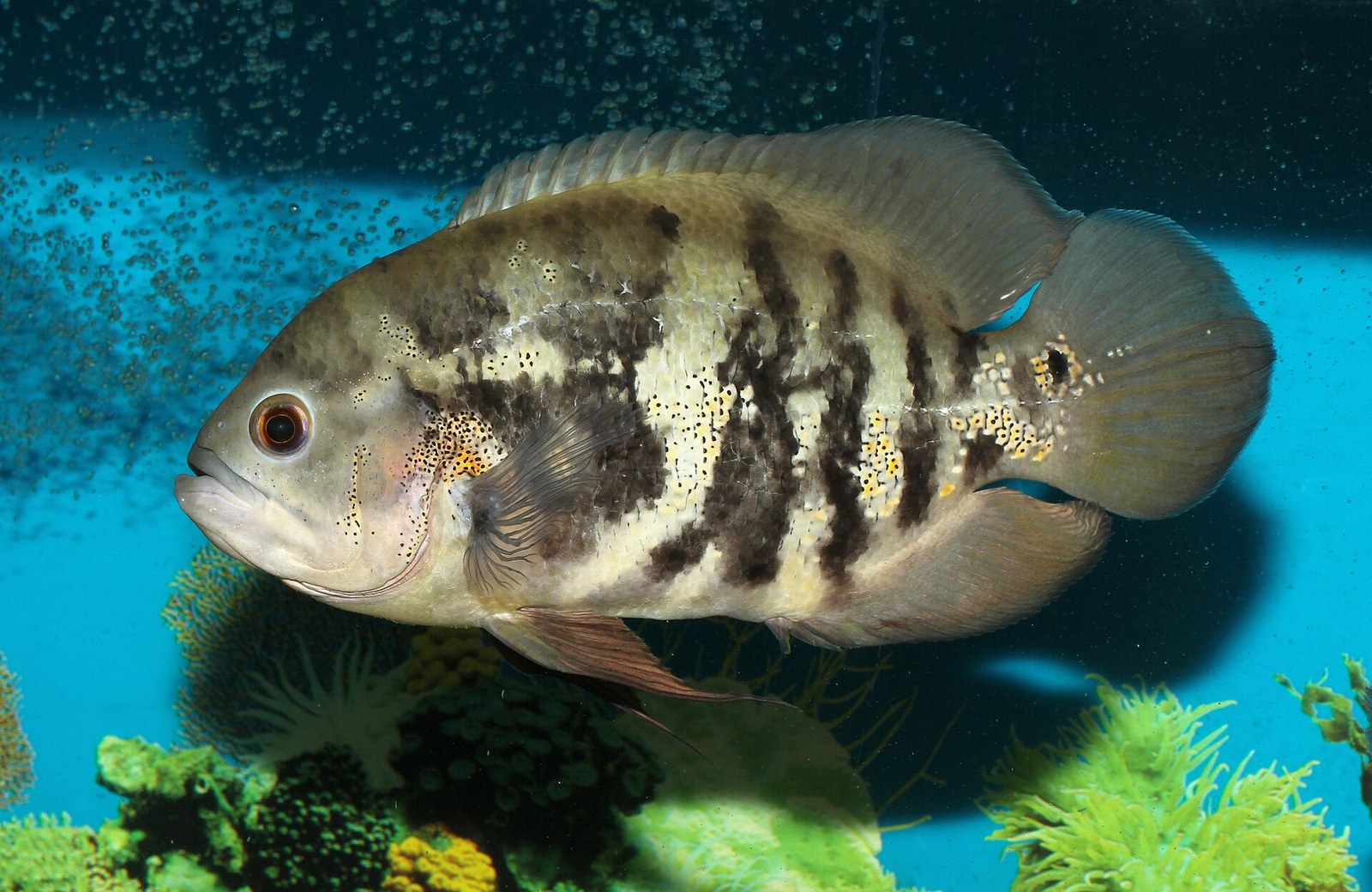
An Oscar care guide should begin with the adult fish, not the tiny specimen at the shop. Astronotus ocellatus becomes a substantial freshwater cichlid with a strong feeding response and the ability to rearrange its surroundings. Your first task is to build a home that remains workable as it grows. Attractive equipment matters less than enough space, accessible maintenance and a stocking plan that does not depend on luck.
Translate adult size into usable space
Seriously Fish lists a maximum of 350 mm standard length, a measurement that excludes the tail fin. The same source describes a 150 x 60 cm aquarium base as just large enough for one adult Oscar. Treat that wording seriously: it is not a generous allowance for several fish, nor a recommendation based on a juvenile's current length.
A base measurement cannot establish volume without water depth. Do not turn it into an exact litre figure, and do not assume a tall, narrow aquarium offers equivalent turning room. Look at the space remaining after filters, wood and other structures are installed. A large fish should not have to squeeze between hard objects every time it changes direction.
Choose a stand designed for the aquarium and confirm that the intended location can support the filled system. Plan hose routes and maintenance access now. A tank that is difficult to service is much harder to keep stable over the long term.
Build around a fish that moves things
Oscars investigate with their mouths and can disturb substrate and decor. Maidenhead Aquatics warns that plants may be uprooted and falling rockwork can be dangerous. Build stable structures with aquarium-safe materials rather than balancing heavy pieces on a mound the fish can excavate. Leave open swimming space instead of filling every corner.
Protect heaters from impact and follow their manufacturer's mounting and operating instructions. Keep cables, intakes and outlets secure. A lid should fit safely around equipment while preserving the ventilation and access the system needs. Check that the fish cannot wedge itself behind a decorative panel or enter an opening it will eventually outgrow.
- Test the stability of each heavy structure before stocking.
- Keep intake guards accessible for cleaning.
- Provide sheltered areas without creating narrow traps.
- Make sure equipment can be reached without dismantling the display.
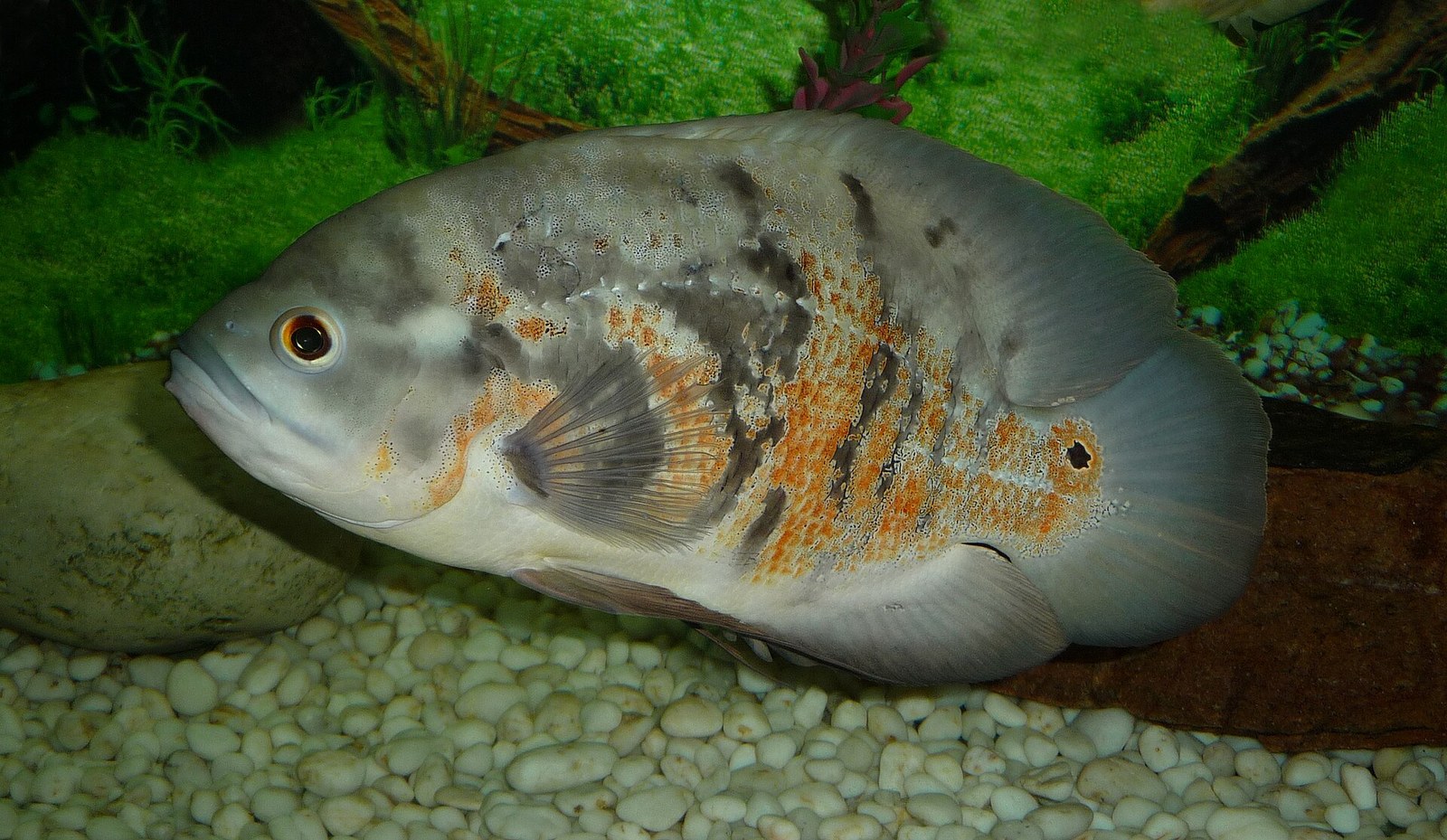
Establish filtration before the arrival
A pump moving clear water is not the same as a mature biological filter. Microorganisms need to establish the capacity to process ammonia from fish waste. Fishless cycling allows that process to develop without deliberately exposing an Oscar to harmful conditions. Follow a coherent cycling method and verify its progress with tests rather than relying on a promised number of days.
Keep records for ammonia, nitrite and nitrate, along with temperature and relevant water chemistry. Before stocking, confirm that the system processes the planned ammonia input without leaving ammonia or nitrite detectable. Introduce livestock cautiously because a filter's capacity must match the actual load.
Oscars produce substantial waste, especially when large meals or uneaten food enter the system. Select filtration you can maintain properly, with sufficient circulation and surface movement. More filter hardware does not cancel the need for debris removal and partial water changes. A backup aeration plan is useful before the first electricity interruption.
Use water references without chasing numbers
Seriously Fish gives an aquarium water temperature range of 20-28 C, pH 6.0-7.5 and general hardness of 5-20 dGH. Those are one source's ranges, not instructions to alternate between their endpoints. Choose a stable operating temperature within the supported range, taking the fish's previous conditions and professional advice into account.
General hardness and carbonate hardness describe different properties. Do not substitute a KH result for a GH result merely because both may be reported in degrees. Understand the tests you own, including whether an ammonia result represents total ammonia rather than only its more toxic un-ionized component.
Prepare replacement freshwater with an appropriate conditioner when the source contains chlorine or chloramine, and match temperature reasonably closely. Avoid repeated chemical corrections to force pH toward a favorite number. If your source water presents a genuine compatibility problem, develop a consistent preparation method before purchasing the fish, rather than improvising during every water change.
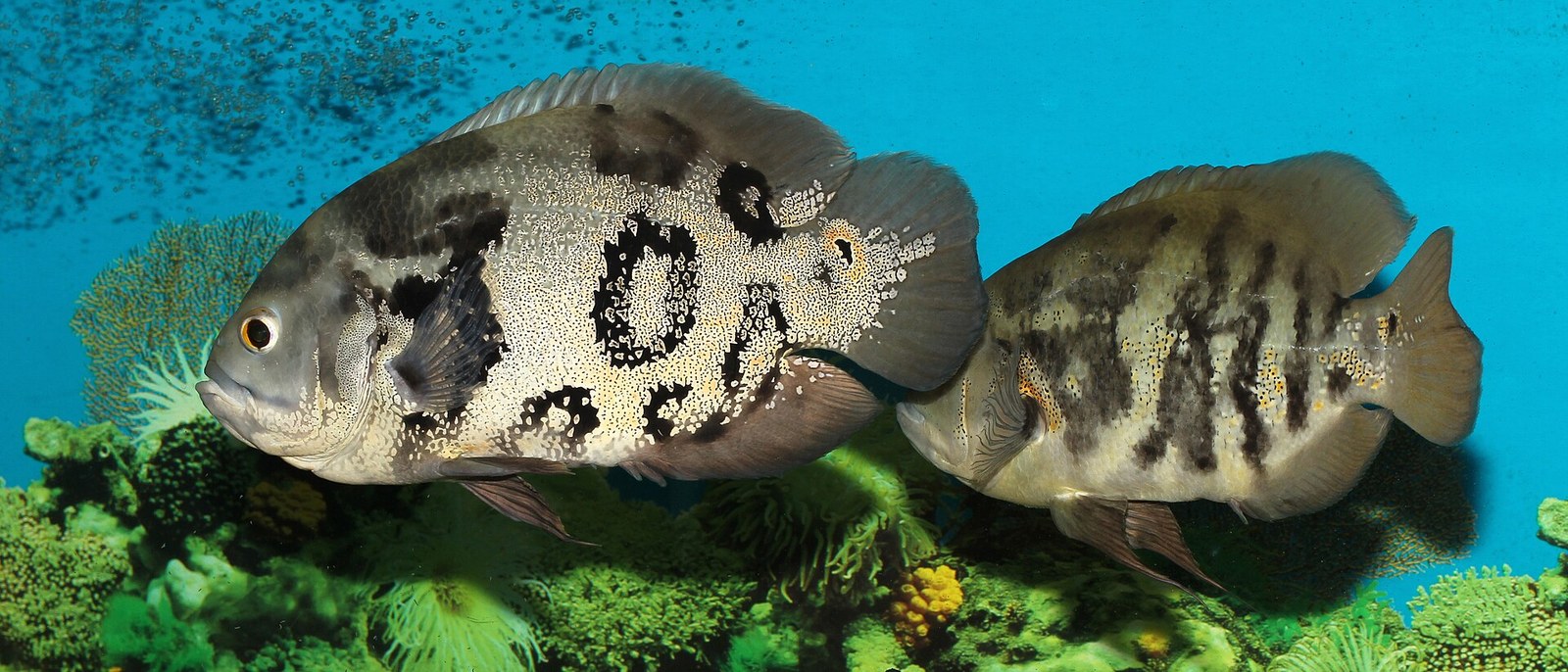
Decide who will live in the aquarium
Seriously Fish describes Oscars as not being community fish. Small companions may be eaten, and similarly sized fish can still fight. A peaceful encounter between juveniles does not establish adult compatibility. Avoid choosing tank mates as decorations or as a supposed cleaning service. Each additional animal adds territorial pressure and waste.
Sources differ about social housing. Seriously Fish supplies the single-adult footprint while favoring pairs; Maidenhead Aquatics more strongly discourages solitary housing. This guide uses the single-adult footprint as an explicit planning reference, not proof that isolation is ideal for every individual. A compatible pair needs a larger design and a separation option.
If you want multiple Oscars, discuss the complete adult arrangement with an experienced specialist before purchase. Be willing to choose a different project if you cannot house incompatible fish separately.
Make the handover calm and observable
Ask the seller about current food, water conditions and recent health history. Prepare a quarantine arrangement with appropriate space, mature filtration and separate tools. Quarantine is not simply leaving a fish in an unfiltered spare container; its environment must support the animal while you observe it. Arrange aquatic-veterinary access before an emergency.
Follow a transport and acclimation plan suited to the journey and the difference between source and destination water. Do not prolong handling merely to follow a ritual, and avoid transferring shop water into the established display. Keep lighting subdued and unnecessary activity away from the aquarium during settling.
Once the Oscar is home, watch respiration, posture and feeding response while continuing water tests. Offer a modest portion of its familiar suitable food rather than a celebratory feast. The strongest start is deliberately uneventful: secure surroundings, functioning equipment and a keeper ready to notice small changes before they become large problems.
Continue reading: Oscar Feeding and Nutrition: Appetite Is Not a Portion Guide.
Sources and further reading:
- Astronotus ocellatus (Oscar) - Seriously Fish
- Oscar - Maidenhead Aquatics
- Management of Aquarium Fish - MSD Veterinary Manual
Photo credits: George Chernilevsky (Public domain (copyright holder release; not CC0)), George Chernilevsky (Public domain (copyright holder release; not CC0)), George Chernilevsky (Public domain (copyright holder release; not CC0)). Images resized and compressed for web display. Each image retains its linked license.


