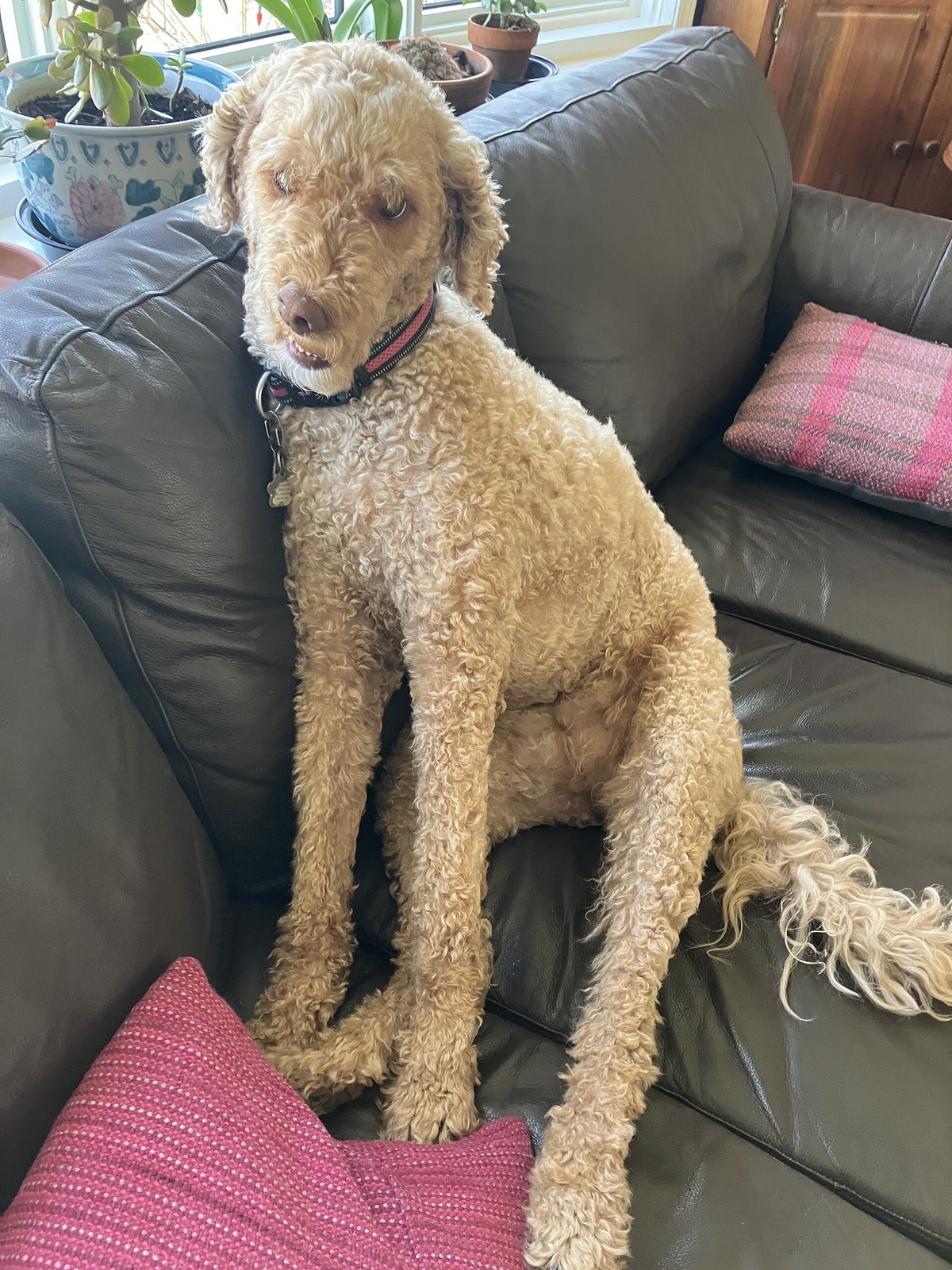
Goldendoodle health cannot be predicted from curls, generation labels, or mixed ancestry. These Golden Retriever–Poodle crosses may inherit susceptibility from either parental family, while ordinary infections, injuries, and age-related disease remain possible. This guide explains how to ask better screening questions and recognize changes that need care. It is not a diagnostic checklist: a predisposition is not a diagnosis, and a reassuring test does not guarantee an unaffected puppy.
Read parent records rather than reassurance labels
For the Golden Retriever side, the Golden Retriever Club of America emphasizes hips, elbows, eyes, and heart. Ask to see results linked to the actual parent's identity and check that the assessment meets the relevant age requirements. Final hip certification is different from an early preliminary evaluation. Eye examinations need appropriate specialist review and currency, while cardiac screening should follow the club's specialist guidance rather than be replaced by a casual claim that no murmur was heard as a puppy.
Poodle requirements differ by variety. The Poodle Club of America lists eye examination, PRA-related DNA testing, and patella assessment for Toy Poodles; Miniatures also need hip assessment. Standard recommendations include hips and eyes with additional specified options such as thyroid, sebaceous adenitis, or cardiac assessment. Ask a veterinarian to review what applies to the actual ancestry, including further mixed generations. A club badge is a starting point for questions, not a substitute for the documents.
Understand what screening cannot tell you
DNA panels and clinical examinations answer different questions. A test for a particular mutation does not assess joint structure, every heart defect, or every cause of blindness. Some conditions involve multiple genes and environmental factors; others lack a reliable predictive test. Results such as carrier, clear, or at risk need interpretation in relation to the specific disease, inheritance pattern, and mating. A vague statement that a dog is genetically clear hides those distinctions.
Normal parent results can reduce some risks without excluding every possible illness. Conversely, missing parent records in an adopted adult do not establish that the dog is sick. Work with the examination, history, and current findings available. Tell your veterinarian about relatives with known conditions when that information exists, but avoid ordering every commercial test indiscriminately. Baseline examination, sensible surveillance, and symptom-led investigation usually provide more useful next steps than attempting to diagnose ancestry from appearance.

Notice joint discomfort before activity becomes difficult
Hip and elbow disorders deserve attention in relevant lines, especially as larger dogs develop. Watch for stiffness after rest, persistent limping, an altered gait, difficulty rising, or reluctance to use stairs. A youngster repeatedly skipping on a hind leg may also need assessment for a kneecap problem, particularly with smaller Poodle ancestry. These observations describe movement changes, not a confirmed diagnosis; injuries and other diseases can look similar.
Do not repeatedly encourage the dog to jump or run to prove that it can. Reduce demanding activity while arranging advice, and use comfortable nonslip access at home. Support lean growth with food suited to projected adult size, avoiding unprescribed mineral supplements. Good nutrition and appropriate exercise cannot eliminate inherited joint disease, but they help avoid preventable complications. Never use human painkillers or another pet's prescription. Veterinary examination and, where indicated, imaging determine what treatment and activity plan are appropriate.
Take eye, heart, skin, and ear changes seriously
Inherited retinal conditions are one reason for parent eye screening, but many eye problems develop outside those test results. Squinting, redness, cloudiness, or sudden difficulty seeing should prompt veterinary contact. A painful eye or abrupt vision change is urgent. Do not use old eye drops: medications suitable for one condition may be inappropriate for another, and a photograph alone cannot establish the cause.
Golden Retriever ancestry also makes cardiac assessment relevant, including subvalvular aortic stenosis. Report unexplained exercise intolerance or coughing and seek immediate care for collapse or breathing difficulty. On a more everyday level, dense coats can hide inflamed skin and painful mats. Head shaking, ear odor, repeated licking, or persistent scratching needs examination rather than a reflex change of food. Allergies, parasites, and infection can overlap. Gentle home observation is useful, but probing an ear canal or pulling apart painful mats is not a diagnostic procedure.

Learn the emergency patterns and act early
Larger, deep-chested Goldendoodles may be vulnerable to gastric dilatation-volvulus, in which the stomach expands and can twist. Unproductive retching, a swollen or painful abdomen, intense restlessness, drooling, weakness, or collapse can be warning signs. Not every sign appears together. Contact an emergency veterinarian immediately rather than waiting for a familiar breed profile to confirm that your dog fits the risk category.
Other emergencies should be just as clear in the household plan:
- Breathing difficulty or collapse, whatever the suspected cause.
- Suspected poisoning or swallowing a dangerous object.
- Heat-associated weakness or abnormal breathing.
- Severe injury, uncontrolled bleeding, or inability to pass urine.
For a larger dog, arrange transport equipment and help before an emergency. Ask your veterinarian whether individual anatomy and history warrant a discussion about preventive gastropexy; it is a clinical decision, not a universal instruction for every cross.
Build a health record that makes changes visible
Routine preventive care should reflect age, locality, travel, lifestyle, and existing illness. Discuss vaccination and parasite protection with the clinic rather than using a rigid internet timetable. Include dental assessment, weight and muscle checks, and grooming tolerance in reviews. A newly irritable dog may be painful, and an older dog slowing down should not automatically be written off as simply aging.
PetMD gives a Goldendoodle lifespan estimate of 10–15 years, with variation among individuals. That estimate is not a guarantee of disease-free years, nor an average calculated from parental lifespans. Plan financially for both preventive care and unexpected investigations. Careful breeding decisions and attentive ownership can reduce uncertainty, but illness is not proof that a family failed to care enough.
Continue reading: Goldendoodle Training: Calm Skills Without Coat-Based Myths.
Sources and further reading:
- PetMD: Goldendoodle
- Golden Retriever Club of America: Health Screenings for the Parents of a Litter
- Poodle Club of America: Poodle Information Online
- PetMD: Pet Grooming—How to Handle Matting in Dogs and Cats
- PetMD: What Are the Benefits of Large Breed Dog Food?
Photo credits: Gogerr (CC BY-SA 4.0), Gullpavon (CC BY-SA 4.0), lyrandian (CC BY 2.0). Images resized and compressed for web display. Each image retains its linked license.


