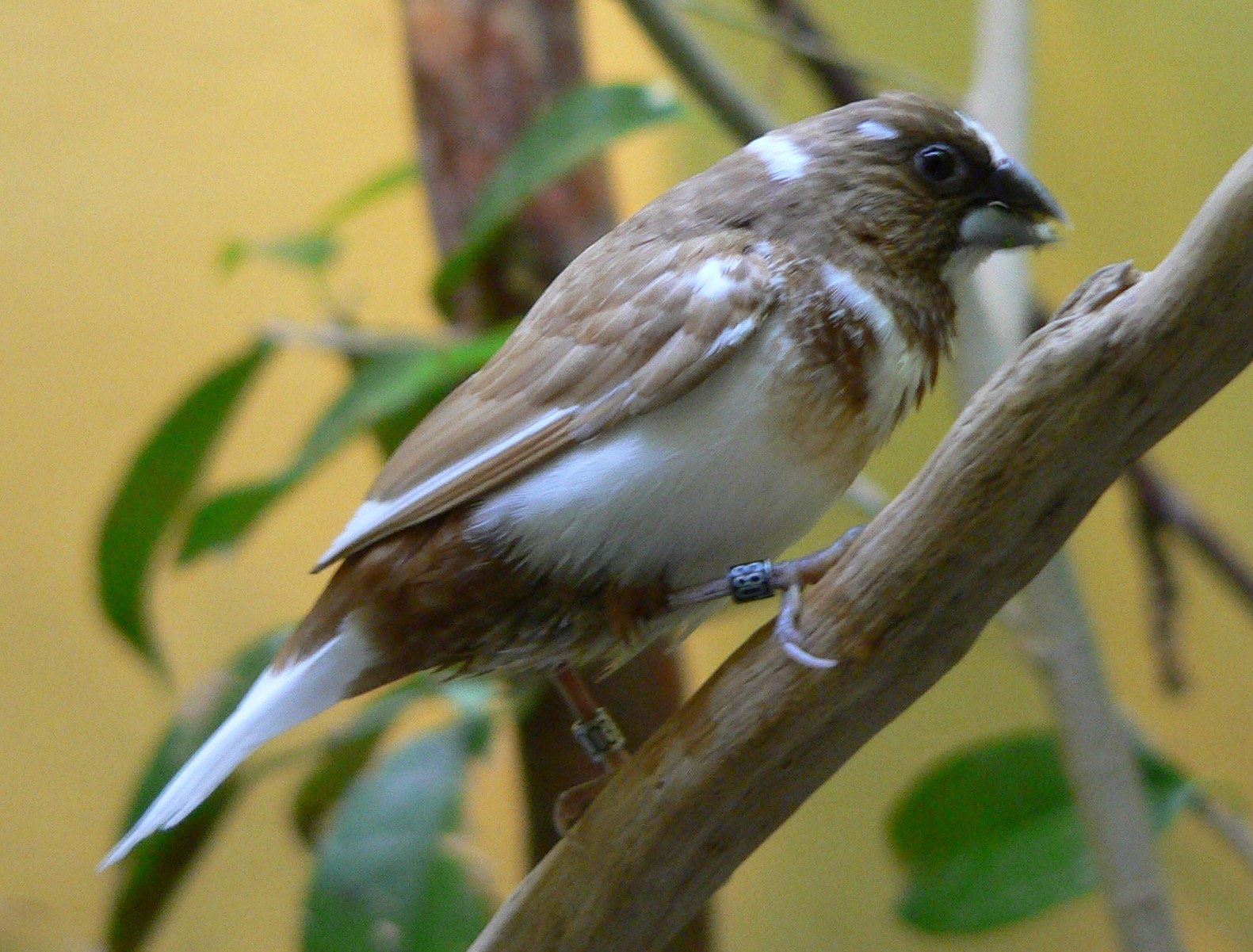
Society Finch behavior is easiest to understand when you stop measuring friendship by whether a bird sits on a finger. These domestic finches are strongly social with other birds, yet many prefer people to remain outside touching distance. Gentle training can still be useful: a finch that stays relaxed during bowl changes, approaches a weighing perch or enters a carrier voluntarily has learned skills that make daily care easier.
Watch the flock before choosing a training goal
Begin with undisturbed observation. Notice how your Society Finches distribute themselves, who follows whom and whether all birds have opportunities to feed and rest. Mutual preening or sitting close can indicate a comfortable relationship, but no single behavior proves that the entire arrangement works. One bird may share a sleeping perch while still being displaced from the preferred food dish.
Write down a small, practical goal based on what you see. For a nervous pair, staying on a perch while you approach may be more useful than taking a treat from your hand. For settled birds, learning a predictable station beside the food bowl can simplify maintenance. Do not make a quiet bird perform for visitors or interpret freezing as consent. Reduced movement can be a fear response, not trust.
Distinguish calls, male song and sudden silence
Both male and female Society Finches use calls, while males normally produce the more organized song. A male may sing in a social or courtship context, sometimes with a visible display. These sounds are usually softer than many parrot calls, but a flock is not silent. Calling when a companion disappears from view is different from singing, and recordings cannot replace the missing social relationship.
The Bengalese Finch is studied for vocal learning and song sequencing. Research comparing domestic birds with white-rumped munias reports population-level changes in song organization and behavior following domestication. That does not imply an individual will imitate human speech or enjoy handling. Nor is a quiet bird necessarily female: settling, age, context and illness all influence vocal activity.
Learn what silence means for your own birds. A previously active singer that becomes persistently fluffed, sleepy or reluctant to eat needs a health check, not louder music or more intensive training. Likewise, repetitive alarm-like calling should prompt a search for a nearby threat, an unsettled companion or a disruptive change in the room.
Make your approach predictable and optional
Move at a pace that lets the birds remain comfortably perched. Approach from where they can see you rather than reaching suddenly from above, and use the same quiet phrase before routine tasks. If they repeatedly flee to the far end of the cage, increase your distance or shorten the interaction. Training should fit around their normal feeding and resting, not replace either.
Use a small portion of a familiar, appropriate food as a reward while the regular ration remains available. Start by placing it in a known dish after a calm approach. Over time, the birds may stay nearer while you do so. Some will investigate food held outside the bars; others will not. Keep fingers and objects from creating trapping points, and avoid moving the reward toward a bird that is trying to retreat.
Voluntary participation means the bird can decline without losing food, companionship or safety. Do not chase, grab, isolate or withhold meals to accelerate progress. A session can end after one relaxed response. Repeated short, successful experiences are more useful than a long interaction that finishes in panic.
Teach a station and a practical carrier routine
A station is simply a perch or position associated with a predictable reward. Place it where the bird already feels secure, then reward calm use without blocking other resources. You can gradually associate a quiet cue with going there. This may allow a companion to eat elsewhere or make bowl changes less disruptive, but it should never become a way of trapping a bird during every interaction.
For weighing, ask your veterinarian about a safe small-bird scale setup. A stable perch or platform can be introduced as an ordinary object before any reading is attempted. Record which bird is on it; two flockmates crowding together do not provide a useful individual weight. If voluntary weighing is impractical, get professional advice rather than starting repeated capture sessions.
- Introduce the carrier where the birds can see it without crowding their cage.
- Let them become familiar with its appearance over several calm encounters.
- Arrange any voluntary entry practice in an escape-proof space with veterinary guidance.
- Reward exploration without suddenly slamming a door on the first approach.
- Build comfort with brief closure only after the bird is settled inside.
Emergency transport cannot always wait for training, but prior familiarity may reduce one source of stress.
Respond to conflict and reproductive behavior early
Society Finches can be companionable without being compatible in every combination. Repeated chasing, feather pulling, cornering and blocking food are not acceptable prices of flock life. First check space, separated resources and whether a nest or favored object is creating competition. If a bird is being injured or denied access, use safe separate accommodation and seek advice rather than waiting for a hierarchy to settle.
Courtship and nest-seeking are signals to review reproductive management. Nonbreeding birds do not need baskets, enclosed sleeping huts or nesting fibers. A same-sex group avoids fertile pairings only when sex is correctly known, and hens may still lay without males. If eggs are already present, involve an avian veterinarian in the plan for that clutch rather than repeatedly removing them.
Add enrichment without making the cage unpredictable
Useful enrichment supports normal finch activities: short flights, bathing, investigating food and choosing a comfortable perch. Try an accessible foraging dish containing a small portion of familiar food, or introduce a safe perch with a different texture. Keep the flight route clear and avoid long threads, loose fibers or gaps that can catch toes. A novelty that blocks the only feeding station is not enriching.
Change one element at a time and watch the response. Curious investigation, normal eating and a quick return to routine are encouraging. Persistent avoidance or frantic flights mean the change is too much, too close or poorly positioned. You do not need to rotate the whole cage every week to prevent boredom.
The strongest relationship with a Society Finch is built on predictability and respect for its flock identity. Measure progress by easier care, confident movement and voluntary choices. Hands-off companionship can be rich and responsive without ever turning the bird into a miniature parrot.
Continue reading: Society Finch Feather Care: Baths, Molt and Healthy Feet.
Sources and further reading:
- Society Finch (Bengalese Finch) Care Sheet — Royal Veterinary Center
- Bengalese Finch (Society Finch) — Christchurch Bird Club
- The genomics of the domestication syndrome in a songbird model species — 2025
- Management of Pet Birds — MSD Veterinary Manual
- Reproductive Diseases of Pet Birds — MSD Veterinary Manual
Photo credits: BS Thurner Hof (Creative Commons Attribution-ShareAlike 3.0 Unported (CC BY-SA 3.0)). Images resized and compressed for web display. Each image retains its linked license.
