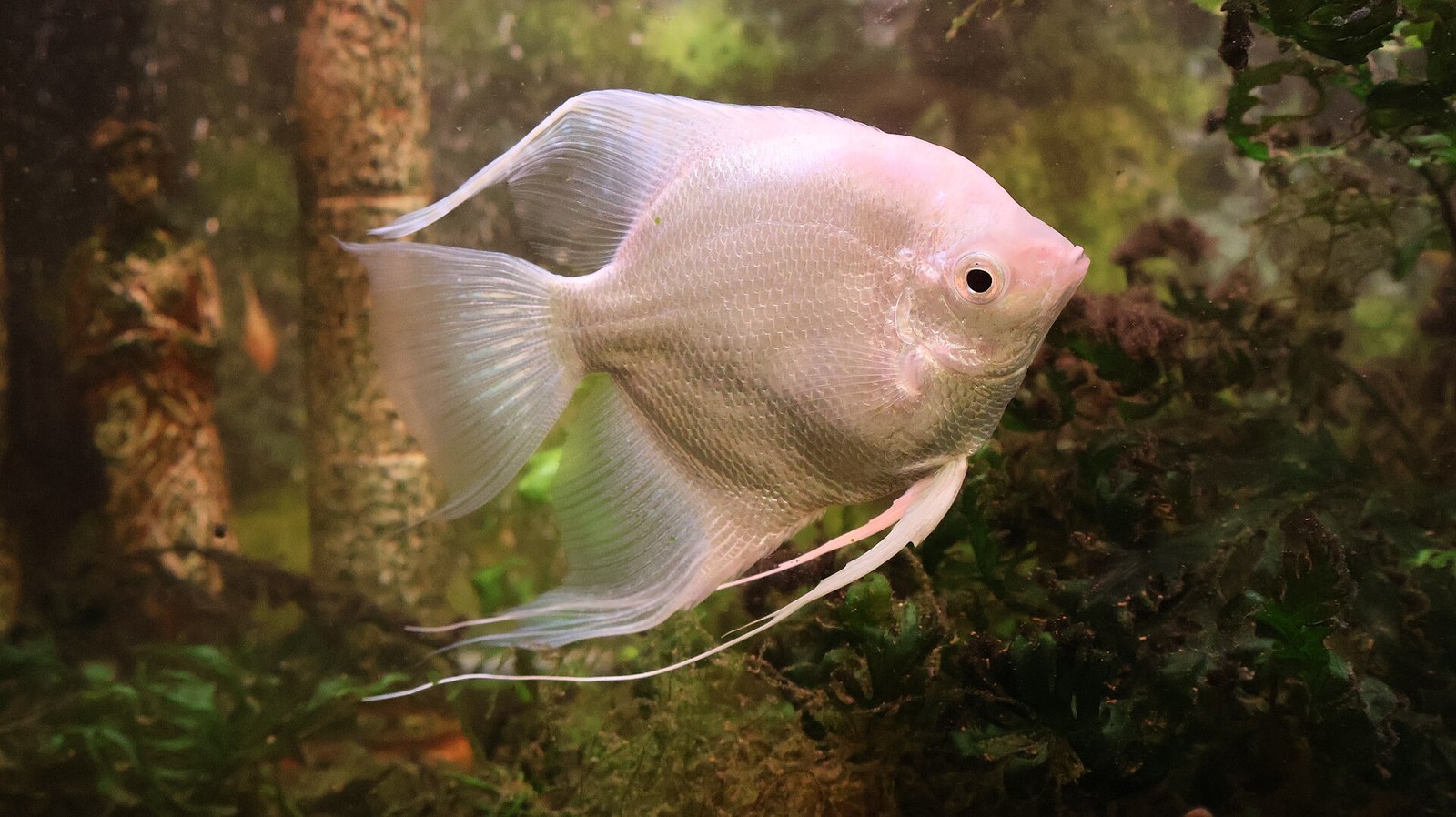
An angelfish care guide should begin with the adult, not the small fish hovering in a shop tank. Those extended fins need room, and a calm appearance does not rule out territorial behavior or predation. A successful setup combines adult swimming space, a working biological filter, and somewhere safe to separate fish if their relationships change.
Choose a tank that accommodates the whole fish
Seriously Fish reports angelfish reaching 15 cm standard length. That measurement excludes the tail fin and says nothing about the distance between the upper and lower fin tips. Look at usable water depth, turning space, and the footprint left after decorations are installed. A narrow tower of water is not a substitute for an aquarium the fish can actually explore.
For adult planning, this guide adopts Aqueon's recommendation of 55 US gallons or larger, approximately 208 liters, with an emphasis on height. This is a starting point for the aquarium, not a per-fish allowance or guaranteed capacity for a group. Seriously Fish lists 100 by 40 by 50 cm separately, without specifying a fish count. Do not combine those figures into a stocking equation.
Position the tank where you can reach the substrate, service the filter, and prepare water changes safely. If the only available location makes routine care difficult, reconsider before buying fish.
Establish the filter before stocking
A biofilter is a community of microorganisms that processes fish waste; clear water alone does not prove it works. Use a fishless cycling method and test its ability to process the intended waste load before introducing angelfish. MSD notes that tropical biofilters can take up to eight weeks to establish, but a calendar cannot replace ammonia and nitrite testing.
Install a reliable heater, independent thermometer, and filtration that moves water without forcing long-finned fish to fight a concentrated jet. Arrange sheltered areas near planting or smooth aquarium-safe wood, while keeping open routes between them. Fish should be able to withdraw from a neighbor without entering a trap.
- Check the stand and aquarium according to their manufacturers' instructions.
- Confirm that heating and filtration run consistently before purchase day.
- Keep dedicated buckets, conditioner and water tests ready.
- Prepare a separate functioning quarantine tank, not just an empty spare container.
Use one coherent water recommendation
Our adopted chemistry guidance comes from Seriously Fish: aquarium temperature 24-30 C, pH 6.0-7.4, and general hardness of 0-15 dGH. These are published care ranges, not instructions to aim at an extreme or allow large daily changes. Ask the seller about the actual water used for your stock and compare it with your prepared aquarium water.
Other sources give different values. Aqueon's 3-8 dKH describes carbonate hardness, whereas dGH describes general hardness. A result in one cannot be substituted for the other. Similarly, an unspecified hardness value in ppm should not be relabeled as dGH. Record the test and unit rather than simply writing down a number.
Introduce fish with social space in mind
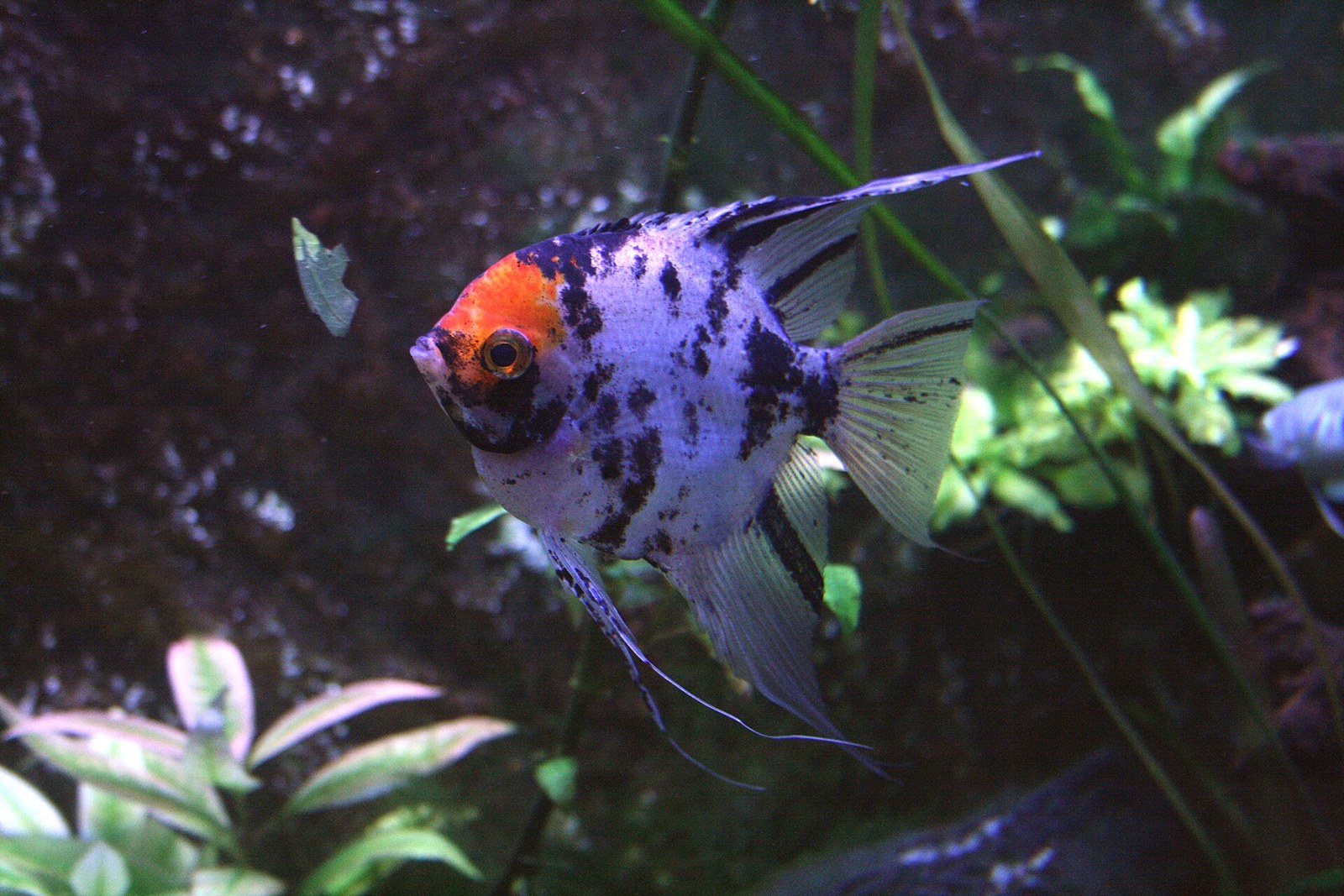
Angelfish are cichlids, and their graceful movement can conceal a strong interest in territory and food. Seriously Fish advises group housing, while Maidenhead Aquatics recommends at least four in a large aquarium. Neither statement guarantees harmony or authorizes that group in the smallest suggested tank. Mature fish and developing pairs can change the social balance.
Quarantine new arrivals separately using dedicated equipment. MSD gives thirty days as a general minimum; illness, treatment or uncertainty may require a longer veterinarian-directed period. Match introduction procedures to the transport conditions and supplier's advice rather than improvising a universal acclimation timetable. Do not pour transport water into the established display.
Choose companions that cannot readily be swallowed and that are unlikely to nip trailing fins. Even then, observe actual interactions. A plan to separate an injured or excluded fish is part of responsible stocking, not evidence that the original plan failed.
Make feeding an individual health check
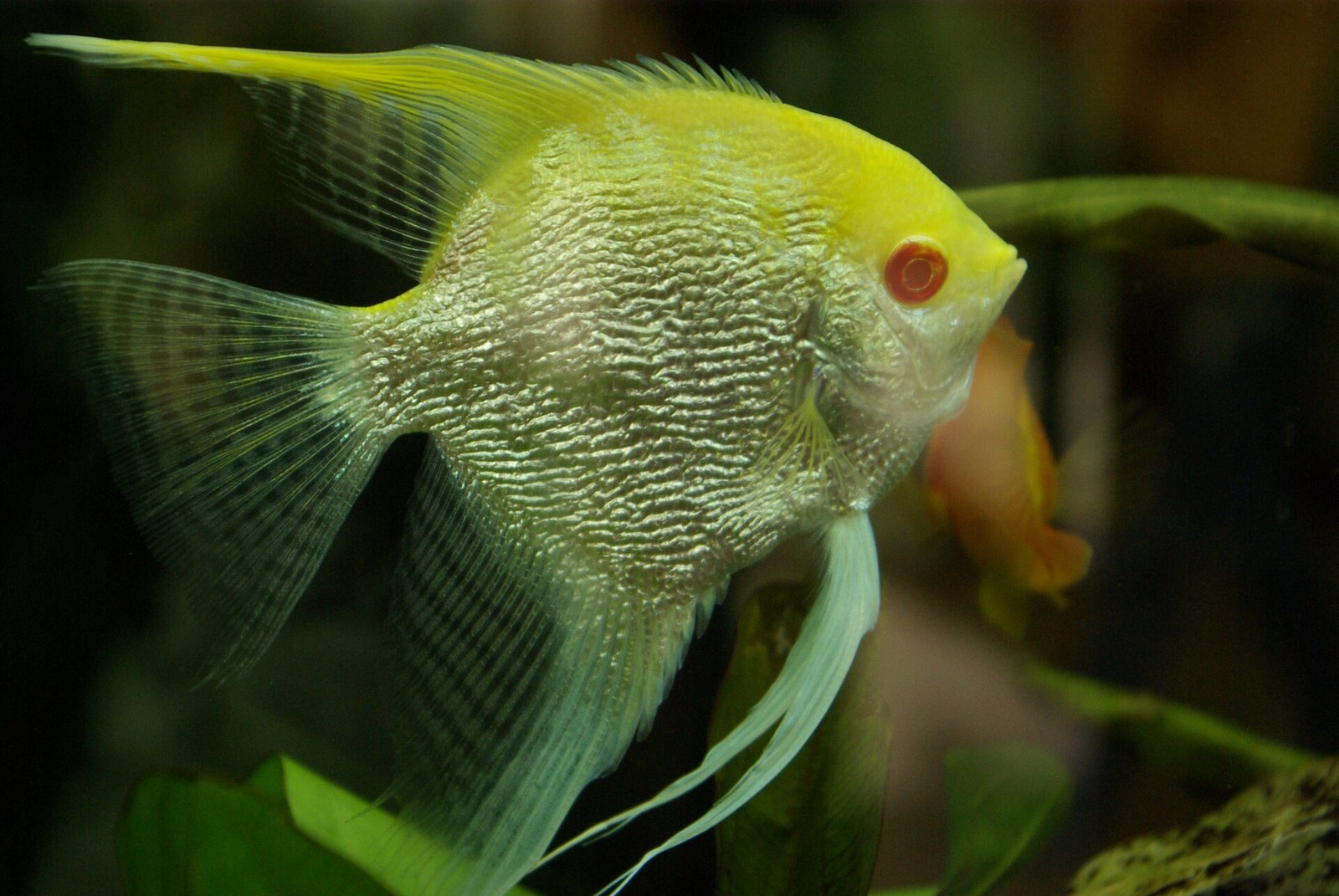
Captive angelfish commonly accept prepared flakes or pellets. Use an appropriate complete food and modest portions of suitable frozen foods for variety. Select a particle size the fish can take comfortably, and consider slowly sinking food when it helps everyone gain access. A dominant fish eating eagerly does not prove its quieter tankmate has received a meal.
Watch food enter each fish's mouth, then check where leftovers settle. Removing debris is more useful than adding extra food because a shy individual missed the first offering. If a fish repeatedly refuses food, review temperature, water tests, social pressure and the food previously accepted before assuming it is merely fussy.
Build a routine that can last
Check breathing, posture, appetite, temperature and equipment operation every day. Use water testing and observed waste accumulation to refine regular partial changes with conditioned, suitably matched water. Preserve the biological filter during cleaning; replacing all mature media at once can undermine the system you worked to establish. Evaporation top-ups do not remove accumulated waste.
Arrange holiday care before it becomes urgent. A substitute keeper needs measured portions, a written equipment check, and a contact who understands fish emergencies. Keep an aquarium-safe separation option available even after a group appears settled. Persistent hiding, wounds, labored breathing, or loss of balance require prompt assessment rather than another decorative adjustment.
The sources reviewed here do not provide a reliable angelfish lifespan range. Plan for long-term maintenance, replacement equipment and responsible rehoming if circumstances change. The reward is not a guaranteed number of years, but a fish whose everyday needs remain manageable throughout your commitment.
Continue reading: Feeding Angelfish: Portions, Variety and Fair Access.
Sources and further reading:
- Pterophyllum scalare (Angelfish) - Seriously Fish
- Pterophyllum scalare Care - Tropical Fish Hobbyist Magazine
- Angelfish Care Guide - Aqueon
- Angel Fish Pterophyllum scalare - Maidenhead Aquatics
- Management of Aquarium Fish - MSD Veterinary Manual
Photo credits: SmallSonMarex (CC0), Karelj (Public domain (copyright holder release; not CC0)), Love Krittaya (Public domain (copyright holder release; not CC0)). Images resized and compressed for web display. Each image retains its linked license.


